
Article
The raging fires in Indonesia are a lesson repeating itself. Beyond the toll on the environment and peatlands, health and economy, they also erode the country's climate commitments.

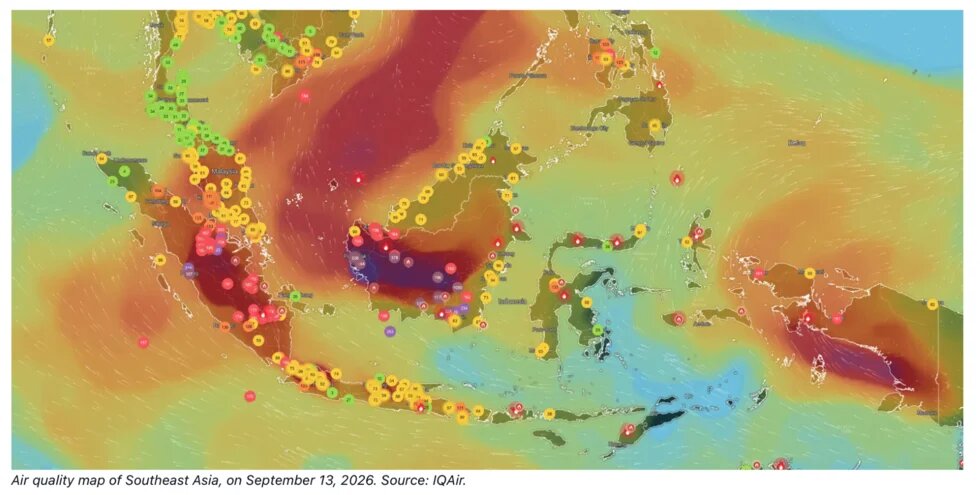
Indonesia is burning again. The recurrence of severe fires during the 2026 El Niño should force a reassessment of how the country defines successful peatland restoration and fire management. Zero-burning policies and partial rewetting are not enough. What Indonesia needs is a strategy designed for extreme drought, unmanaged land and a changing climate.
Indonesia has spent the past decade trying to ensure that the fire catastrophe of 2015 would not happen again. Following that crisis, the country strengthened its peat fire-prevention policies. The BRGM (Badan Restorasi Gambut dan Mangrove) or Peatland and Mangrove Restoration Agency was established in 2016, yet it was dissolved in 2024. Millions of dollars were invested in peat restoration. Yet Indonesia is burning again.
There is indeed inconsistency in the regulations and laws related to fires, but we have already seen how the zero-burning policy is a failure.
On paper, the message is clear: burning forests and land is prohibited. A range of forestry and environmental regulations establishes this principle, while Article 69(h) of Law No. 32/2009 recognizes a limited exception for clearing land, based on local wisdom. For example, regional regulations in West Kalimantan province and its Sekadau regency also recognize traditional land-clearing practices under specific safeguards. Yet in response to the fires this year, the Indonesian government once again tightened the zero-burning approach through Ministry of Environment Circular Letter No. 16/2026 and Presidential Instruction No. 11/2026.
This risks seeing a repeat of a lesson that Indonesia should already have learned by now. Without strong prevention programmes, appropriate social approaches and effective law enforcement, a ban on burning is unlikely to deliver lasting results.
Zero burning is not enough. It is not as simple as stating that Indonesia can prevent people from burning. Given how much we have invested, and how many regulations have been put in place to prevent fires, the question is whether restored peat landscapes can remain wet and fire-resistant when the climate becomes exceptionally dry, as it has been this year.
Indonesia’s zero-burning policy is important, but it has ultimately failed because it misses addressing an important factor: where fires actually occur.
Fire Resilience
Again and again, the history of fire on Indonesian peatlands has shown shrubland and unmanaged land to be the major fire hotspots, whereas managed land is among the least fire-prone categories. This distinction matters. A zero-burning policy cannot solve this physical vulnerability. We now need to move from zero burning towards a paradigm focused on prevention and early detection, one that involves local communities. We must restore degraded areas and prevent forest fires where they most often occur – and do this early enough. At the same time, we can improve people’s sources of income by promoting land preparation without burning, with the use of technology and innovation. The objective should be not merely to prevent fires, but to create landscapes that are resilient to fire.
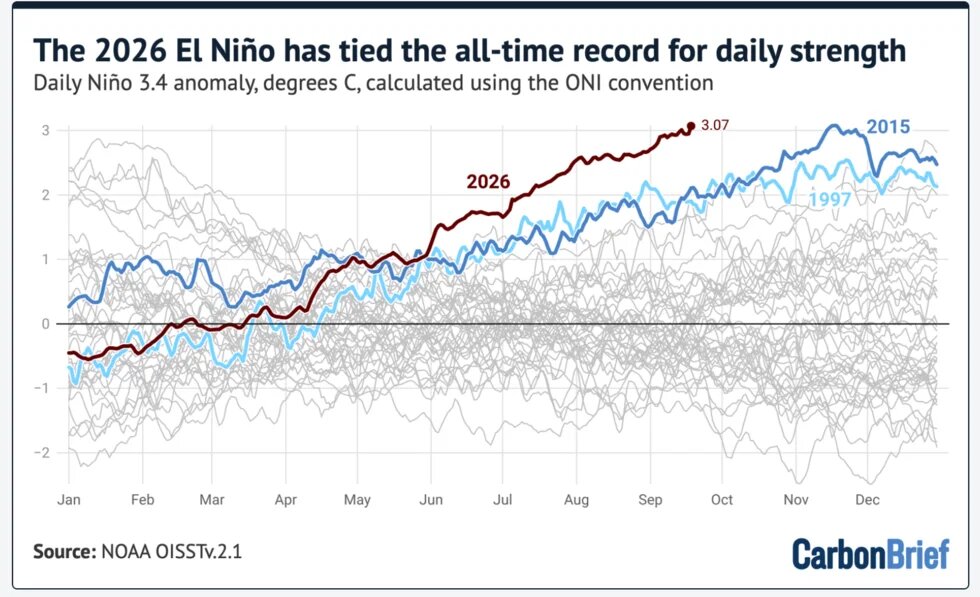
Above: Sea-surface temperature anomalies are already over 3C, exceeding past El Niño episodes and doing so earlier in the event. These anomalies are tracked using the Oceanic Niño Index (ONI) in the Niño 3.4 region, an area in the equatorial Pacific.
We also want to highlight how peat restoration approaches are implemented in areas with different levels of fire risk. For instance, research has shown unclear degrees of success from fire prevention through peat restoration. In 2019, restoration significantly reduced fires in Indonesia – but this impact was not seen during the 2023 El Niño event, according to a 2026 study. Recent contrafactual analysis in a study led by Yayasan Konservasi Alam Nusantara (YKAN) showed that 3,840 canal blocks in Kalimantan reduced fires by no more than 6.4%.
So we must ask: Are we restoring peatlands at sufficient scale and with the right approach to face El Niño? Let’s be honest, the answer may be no, we are not.
In addition, a water-table threshold such as −40 cm should be regarded as a management benchmark only in plantations, but not in unmanaged areas and shrubland. The -40-cm level should not be treated as the endpoint of ecological restoration. During an El Niño, water levels can fall far below such thresholds. In these conditions, dry peatlands are a carbon bomb – fuel available to ignite fire.
The success of peat restoration in Indonesia is usually measured from how many canal blockings are installed, how much area is restored from revegetation and rewetting, the number of wells, and thousands of groundwater level data points that are not accessible to the public. But the real question should be: Can the restored peatlands in the landscape survive El Niño episodes – without burning? A major shift in strategy is needed, one where restoration is prioritized and indicators of its success are put in, so that investments can be directed towards the landscapes that contribute most to peat fire and emissions. Shrublands and unmanaged areas deserve much greater attention. These landscapes should not be treated as marginal areas simply because they are not productive plantations or intact forests.
Peat Fires Undercut Climate Commitments
The 2026 El Niño event should not have been an unexpected disaster. We have long experience with El Niño patterns that occurred in 1997, 1998, 2015, 2019 and 2023. Viewed in this context, the 2026 fires are not a warning, but history repeating itself. They prove that Indonesia’s zero-burning policy and its current approach to peatland restoration have not made fire-vulnerable areas in unmanaged land resilient enough during this extreme El Niño – that we were warned about.
In its Nationally Determined Contribution to the UN climate convention, Indonesia has a target of achieving FOLU Net Sink 2030, a commitment to achieve net-zero emissions in the Forestry and Other Land Use sector by 2030. We know that peat fires are part of the emissions from the forestry sector, which account for about 50% of the country’s national emissions.
The credibility of Indonesia’s climate mitigation strategies is at stake if the country fails to make a serious effort to prevent peat fires.
___
Nisa Novita is Peatland Strategic Lead at the Yayasan Konservasi Alam Nusantara (YKAN).
Israr Albar is a member of the Core Working Group International Interoperability, Fire Management Hub of the UN Food and Agriculture Organization.
This article was first published on 22 September 2026 by Reporting ASEAN as part of its Sustainability Series supported by Heinrich Böll Stiftung Southeast Asia.
Disclaimer: This published work was prepared with the support of the Heinrich Böll Stiftung. The views and analysis contained in the work are those of the author and do not necessarily represent the views of the foundation. The author is responsible for any liability claims against copyright breaches of graphics, photograph, images, audio, and text used.


