
Article
Indonesia is the world’s seventh-largest cocoa producer and the third-largest exporter of cocoa beans. Despite growing demand for cocoa, farmers face climate change impacts, aging cocoa trees, and environmental degradation, making the country’s cocoa sector more vulnerable to weather-related disasters.

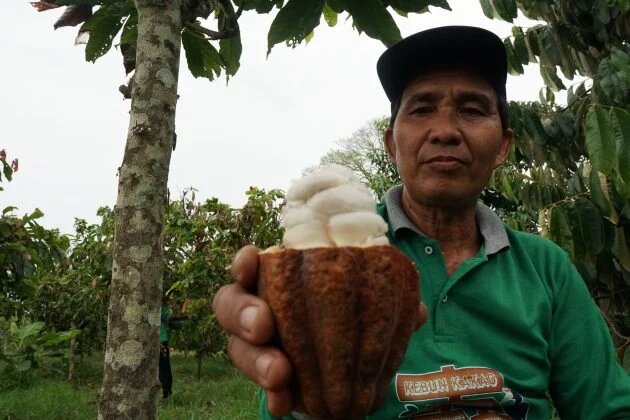
“I’ve got nothing this harvest season,” sighed cocoa farmer Ujang, speaking from his home in Merasa, a village in Berau district, located in Indonesia’s Eastern Borneo province. This is the first time he has experienced a crop failure in all his 30 years as a small farmer.
The latter part of the year, from September to December, is typically harvest season for the crop. It is the rainy season, but it has been so much wetter than usual this year. This has wrecked his harvest, says Ujang.
For weeks, he says, unceasing streams of heavy rain in soaked his cacao trees, making their way deep into the roots of cacao trees on his plantation in Merasa.
“Ideally, the harvest time is twice a month. I could get 150 to 200 kilogrammes of cocoa every harvest season, when the situation is normal,” Ujang said in a phone conversation in November.
On the morning of that conversation, he had – once again – cancelled plans to go into the forest and check on his crops because of the extremely heavy rains. Since the start of November, he had been able to go to his farm only for “cleaning, cutting branches, making sure the young cocoa trees still could grow,” he said.
Abnormal Weather
In truth, the entire 2025 has been far from normal in terms of the weather and the environment, changes that for him are related to the larger impacts of climate change.
Through the year, his village has been hit by floods at least seven times, Ujang recalls. Floods caused by unusually heavy rain do not only cause immediate damage to farms like his – they erode the fertility of the soil that is key to why cocoa thrives in Indonesia, near the equator. The Southeast Asian country is currently the seventh largest cocoa producer in the world, although it used to be the third several years ago.
“I used to own three hectares of cocoa trees. But now only 1.5 hectares remain because the trees died due to flooding,” Ujang pointed out.
The heavy rains, which disrupted the usual weather cycle, caused the cacao tree blossoms in Berau to drop prematurely. “Among thousands of cacao flowers that grow in one tree, only four to five percent could turn into cacao fruit,” said Rizky Putri Hayuningtyas, an Eastern Borneo staffer from Yayasan Konservasi Alam Nusantara (YKAN), a nature conservation foundation based in Jakarta.
Looking back, Ujang continues, changes in land use in his community have also caused environmental degradation, making it more vulnerable to disasters when weather hazards come. For example, he reflected: “Now there are many companies operating in the village and the forested areas continue to decrease. So when the rain comes at night, the flood will certainly happen the morning after.”
A degraded environment – in a world where global temperatures have been rising and affecting the cacao harvests in West Africa – may also mean less resilience at a time when weather patterns like La Nina are active, as it is at present.
La Nina, which is expected to remain for some more months into 2026, tends to cool parts of the Pacific Ocean and bring more rainfall in parts of Southeast Asia, such as Indonesia.
In Borneo island, the rains have come earlier than usual, and the rainy season will stay longer too. In fact, the wet season in this region began in August, instead of the typical September.
The La Nina phenomenon in the country will last longer than usual, the Indonesian Agency for Meteorology, Climatology, and Geophysics (known by its Indonesian acronym BMKG) announced in October 2025. It said that La Nina had entered its peak moment in November to December 2025 – when Ujang was seeing heavy rains in his hometown – and would last until the middle of June 2026.
“We need to stay alert for hydrometeorology disasters (flood, landslides) as a result of the long rainy season,” said Riza Arian Noor, head of the meteorology station at the BMKG in Samarinda in Eastern Borneo.
High Demand But…
Ujang’s troubles from the unpredictable weather reflect part of the mix of challenges that are holding back Indonesia’s capacity to significantly increase production and take advantage of the opportunity to fill the gap in world cocoa supply.
Demand has been high for several years now, after the cocoa industries of Ivory Coast and Ghana, the world’s largest cocoa producers, were hit by droughts and extreme heat events, including the El Nino weather pattern in recent years.
Ironically, as Indonesia tries to boost its cocoa production, its cocoa sector is also feeling the impacts of a changing climate, though in different ways.
In the wake of declining cocoa outputs in Africa and the resulting high demand for these, cocoa prices have been rising and reached their highest levels in decades in 2024. While this has eased somewhat, prices remain elevated.
Even without this year’s weather events, Indonesia’s cocoa production – dominated by small farmers and plantations – has been declining over the years. The land area planted to cacao has been shrinking as well.
These have been the trends since 2018, according to the yearly ‘Indonesian Cocoa Statistics’ of the Statistics Indonesia, the government’s statistics agency.
Cocoa bean production fell from 767,280 tonnes in 2018 to 632,120 tonnes in 2023, during which the total area planted to cacao declined from some 1.56 million hectares to 1.39 million hectares. In 2024, Statistics Indonesia said cocoa production fell further to 617,110 tonnes.
Most of Indonesia’s production (99.59% according to Statistics Indonesia) comes from smallholders like Ujang. These small farmers grow cacao across 1.36 million hectares of land, mainly in central, south and southeast Sulawesi.
Ageing Trees, Pests, Technology
Discussions around declining cocoa production and increasing productivity focus on the need to revive an industry that faces challenges ranging from ageing trees to the need for a technology upgrade. Many farmers are also shifting to other crops seen as more profitable, such as palm oil and sugar cane.
The Indonesian government is pursuing a replanting and revival programme for cacao farming.
In July, President Prabowo Subianto said: “Global chocolate prices are very high, and many are expecting chocolate from us. We have to [start] replanting soon, rejuvenation, and we will carry out these measures.”
The Ministry of Agriculture has a rejuvenation programme for land planted to cacao covering 175,000 hectares in 2026, local news reports quoted agriculture ministry official Yakub Ginting as saying. The target for replanting in 2027 was 248,500 hectares, he said.
In Central Sulawesi, farmers face challenges because of ageing cocoa trees and diseases that plague the trees. (Majority of Indonesia’s cocoa trees are more than 20 years old, or close to the maximum productive age, according to the Indonesia Cacao Board’s Soetanto Abdoellah.)
Salua in Central Sulawesi used to be the home of cocoa, recalls Usman Husen, a large-scale farmer and entrepreneur who is from the village. “But the big earthquake hit Central Sulawesi in 2018, destroying cacao farms and [the livelihood of] its people. Five years after the disaster, people were still recovering and they had not fully come back to revitalizing the cocoa plantation,” Usman said in an interview.
That was the time, in 2023, that Usman returned home from working in Surabaya in Java island to find a way to optimize cocoa planting in Salua.
He found out that the soil in Salua’s cacao plantations had lost its nutrients because of the heavy use of pesticides. “The soil had dried and hardened, making it unproductive,” said Usman.
He decided to “buy cocoa seeds, collaborating with a third party to buy organic fertilizer, buy the land, and ask some of the local young people to be farmers”. Today, he owns 25 hectares of land in Salua, with each hectare planted to around 800 cacao trees.
Usman says cocoa farmers also need government assistance especially in learning how to increase the productivity of cacao trees and how to add value to cocoa products, such as producing cocoa powder and cocoa butter instead of just raw cacao.
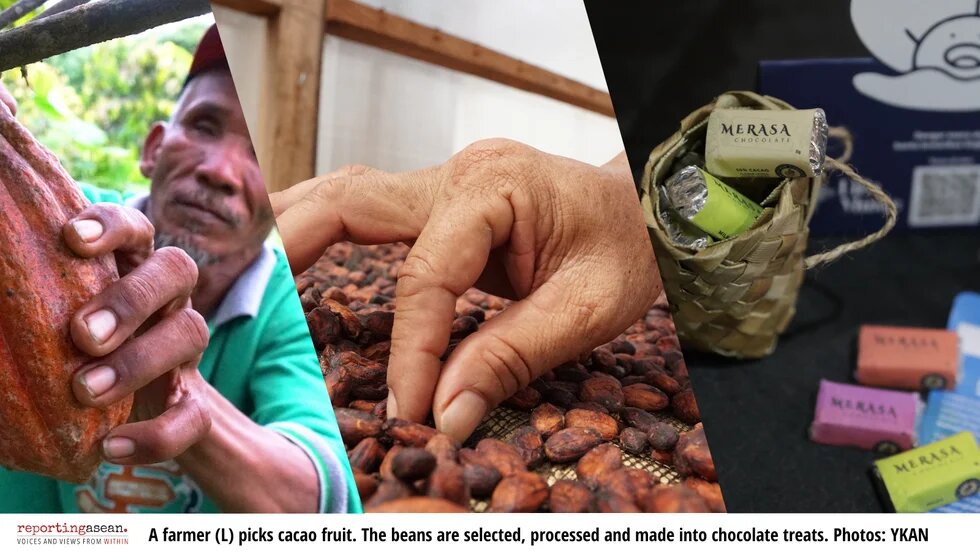
There are many challenges besides climate change in Indonesian cocoa production, Rizky explains. “In the upstream, a large number of trees have been hit by disease and pests, aging trees, land use change,” she said. “In the downstream, there are still a few farmers that want to explore post-harvest processing such as cocoa bean fermentation,” she added, explaining that this process takes time but “the farmers now need to get the money on a daily basis”.
Selling fermented cocoa beans commands higher prices since they need to meet the standards of chocolate manufacturers. But it takes more time that selling raw cacao beans, which would bring income to farmers faster.
Rizky also notes that many farmers remain reluctant to form groups, even though doing so would improve their access to government support programmes. “Not all farmers are enthusiastic about joining farmers’ groups, and encouraging them to take a long-term approach to managing income from harvests remains a challenge,” said Rizky.
Importer and Exporter
Because domestic cocoa production falls short in quality and quantity, Indonesia imports large volumes of cocoa beans.
Most imported cocoa is used by the country’s cocoa processing industry to produce value-added products for the domestic market and to boost the competitiveness of processed cocoa exports. Indonesia is the third-largest exporter of cocoa beans, enjoying a windfall from exports (mostly as cocoa butter) given the high prices of cocoa globally.
The country imported 148,320 tonnes of fermented cocoa beans in 2024, most of it from Malaysia, according to Statistics Indonesia.
The value of Indonesia’s exports of cocoa products jumped sharply in 2024 and is expected to remain high in 2025 due to elevated cacao prices.
In 2024, the country’s exports of cocoa and cocoa preparations fetched 2.65 billion US dollars, more than double the 1.2 billion dollars worth of exports in 2023. Yet the volume of exports in 2024 was 348,090 tonnes, not much different from the 340,000 tonnes for 2023.
Local media reported that exports reached 1.6 billion dollars in the first five months of 2025 alone, for 144,000 tonnes of cocoa products.
Social Forestry for Smallholders
Initiatives to improve smallholder plantations are still sporadic across Indonesia. In Berau, however, the local government makes regulations to boost cocoa production. The local regent sets regulations on the establishment of a cocoa agribusiness centre.
“Social forestry became a strategic approach in combating the challenge (of decreasing production) that has been faced by smallholders,” told Rizky. “Social forestry not only increases economic benefit but also contributes to stopping deforestation.”
Indonesia has been enjoying a windfall from exports (mostly as cocoa butter) given the high prices of cocoa globally. This is even if its domestic cocoa production has been falling.
In Berau, YKAN works with local farmers in developing farmers’ groups and implementing agroforestry-based systems. “We also encourage the smallholder to do cocoa fermentation so they can get better pricing (for their products),” said Rizky.
Some farmers who joined the YKAN Internal Control System programme are learning how to carry out further development of harvested products, to bring in more revenues. They have been working with Pipiltin, an Indonesian cocoa brand, and supplying it with fermented cocoa beans. “We send Grade A beans to Pipiltin,” said Rizky. Other cacao products are sent to cafes in Berau and sold in local stores on the island.
___
Johanna Son, who has covered Southeast Asia for over three decades, is the editor and founder of the Reporting ASEAN series, whose newsletter is here.
This article was first published on 29 December 2025 by Reporting ASEAN as part of its Sustainability Series supported by Heinrich Böll Stiftung Southeast Asia.
Disclaimer: This published work was prepared with the support of the Heinrich Böll Stiftung. The views and analysis contained in the work are those of the author and do not necessarily represent the views of the foundation. The author is responsible for any liability claims against copyright breaches of graphics, photograph, images, audio, and text used.


