
Article
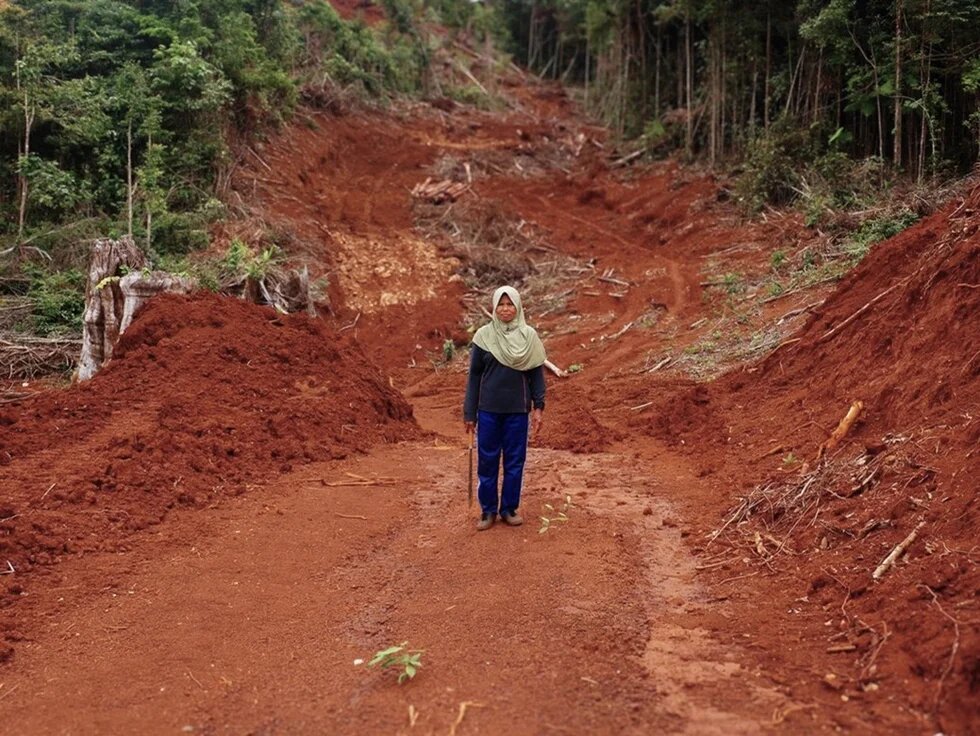
Capitalist patriarchy drives mineral extraction, treating nature and women as interchangeable resources for profit. Materialist eco-feminism reveals how this system makes exploitation look natural. In Southeast Asia, the nickel boom has stripped forests, poisoned water, and erased livelihoods. Women bear the heaviest burden: walking farther for clean water, losing the land they farm, carrying mercury in their blood. This is not a failure of policy. It is how the system works. And it is now dressed in green.

Introduction
What are we really talking about when we call Southeast Asia's minerals both "treasures" and "tragedies"? Treasures for whom, and tragedies for whom?
The world needs minerals: nickel from Indonesia, rare earths from Myanmar, tin from across the region. As global demand doubles by 2050, the driving force is not human need but a system that equates progress with endless consumption.
But extraction brings tragedies, documented in forests stripped, rivers poisoned, and communities displaced.[1] We are at a crossroads: one path leads to transformation, the other to fossil fuel harms.
This framing takes us far, yet the tragedy is not weak safeguards. It is structural, built into a system that sees the planet as raw material and communities as obstacles. Understanding why requires looking at the logic that holds this system together and who it was built to serve.
The simple truth: the exploitation of minerals and the exploitation of women are products of the same system. Making this connection visible is the work of materialist eco-feminism. Through this lens, the question shifts from how to extract cleanly to whether the model of extraction can be reimagined.
Materialist Eco-Feminism
At its core, mineral extraction is shaped by capitalist patriarchy. It treats nature and women as resources for those who control capital and power. That those people are mostly men is no accident.
Materialist eco-feminism exposes how the system works through paired ideas: mind over body, culture over nature, man over woman. In what eco-feminists call dualism, the first is treated as superior, the second is inferior and meant to be ruled. This dualism makes exploitation look natural. It teaches us to see the planet as lifeless and women as bodies to be managed.
Whole economies are built on this system. Consider nickel extraction in Indonesia: after the Paris Agreement, investment surged, attracting $6.6 billion between 2016 and 2023. In 2023, Indonesia and the Philippines together accounted for 63 percent of the world's nickel output.
But this is not progress. It is the same old system dressed in new language: take what you want, leave the damage, count the profits, ignore the costs.
What gets ignored is the subsistence perspective: the unpaid work of sustaining life that capitalism renders invisible and mining destroys first.
The evidence is clear: groundwater becomes contaminated and unfit to drink, forests stripped, soil depleted.[2][3]
As mining camps bring an influx of male workers with no connection to the place or its people, research shows a deep alienation between workers and locals, where hierarchies of race, gender, and class become normalized.[4][5]
For local women, this is not abstract. It shapes who moves through their villages, who controls the roads, who feels entitled to their bodies. As male workers flood in and traditional structures collapse, the conditions that make women unsafe are not incidental. They are built into the system.
Capitalist patriarchy does not see any of this as loss. It can only see what can be sold; the rest is external, not its concern.
This is the system we face, and it now presents itself as the solution to the very crisis it created.
Gendered Extractivism
What does capitalist patriarchy look like in a community? Look at women who live near mines.
Start with water. When mines move in, rivers run toxic.[6] In West Lombok, Indonesia, mining contaminates water with heavy metals, seeping into the ground and moving through the food chain, poisoning plants, soils, and fish.[7][8][9] Further north, farmers along the Kok River in Thailand are warned not to use the water due to contamination from unregulated rare earth mining operations upstream in Myanmar, where weak enforcement allows toxic runoff to drift across borders.[10]

For women, this also reshapes their labor. Women collect water, cook with it, wash their children. When clean water moves farther, their day grows longer. When rivers die, they must walk until they find clean water.[11] The burden falls entirely on them. There is no tap, no truck, no alternative. Only their own feet, carrying water back home day after day, while the companies responsible count their profits elsewhere.
The same pattern holds for food. Mining does not just take minerals. It takes land across Indonesia.[12] In Kalimantan, women who once grew enough rice for their families lost almost everything. One woman, Satar, saw her 15 hectares shrink to one. She now buys rice she once grew. In Sumbawa, women lost palm sugar income. In South Kalimantan, rubber plantations vanished. In North Sulawesi, milkfish catches fell where mines dump waste.[13]
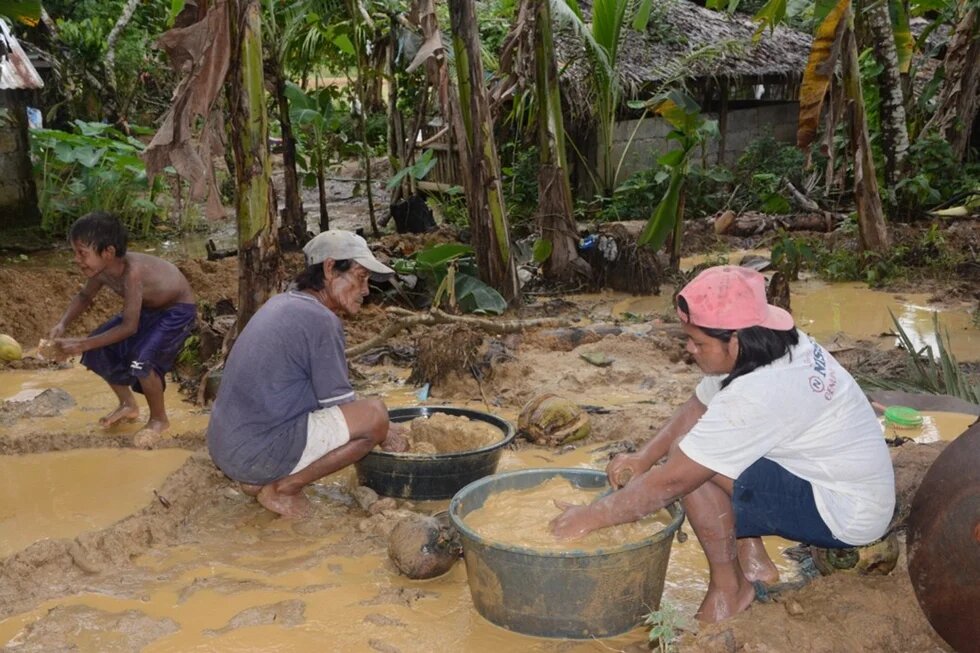
What is destroyed is not only land and water, but also the bodies of those who work closest to the extraction. In the Philippines, tests found mercury in the blood of women exposed while mining years earlier. Officials hid the results, fearing panic.[14] These women had worked in small-scale gold mining, handling mercury with bare hands. Many were mothers. The mercury in their bodies would pass to their children, causing birth defects and developmental problems.
These are not isolated harms. They share a common logic: the system takes what it needs and leaves women to absorb what remains.
The subsistence perspective names the work that keeps life going: growing food, collecting water, raising children, caring for the sick.[15] Though essential, this work is not counted in GDP nor valued by markets. It is performed mostly by women, often without pay, and it is treated as if it costs nothing. Capitalist patriarchy depends on this invisibility, building whole economies on the assumption that this labor will always be there, free, and unlimited, while extracting value from everything else.[16]
Mining destroys this work first. When water is poisoned, women walk farther. When land is taken, women lose the food they once grew. When forests are cleared, women lose plants used for medicine and income. The subsistence perspective makes visible what the system renders invisible: that the exploitation of nature and the exploitation of women are one and the same.
In West Lombok, it is the poisoned water. In Kalimantan, it is the lost land. In the Philippines, it is the mercury in women's blood. Each is a different face of the same system. The system counts only profit, and women pay for the rest.
Conclusion
We began by asking: treasures for whom, tragedies for whom? We now have an answer.
The rush for critical minerals is not technical. It is political. The system that shapes extraction treats nature and women as resources to be used up and thrown away. It counts profits while ignoring women who walk farther for water, lose their land, carry mercury in their blood. This is not unfortunate. It is the system at work.
The dossier calls it a crossroads: one path leads to genuine transformation, the other repeats the harms of fossil fuels. The crossroads is real, but women are already leading the way. In Raja Ampat, Indonesia, women, indigenous communities, and activists pushed back against nickel mining threatening one of the world’s most biodiverse marine ecosystems. Their campaign forced the government to revoke four mining permits in June 2025.[17] If the transition is to be just, it must be built by the women who have always sustained life. The rest is just extraction dressed in green.
___
Jericho Dahilan is a researcher based in Thailand. He is a Master in Asia-Pacific Studies candidate at Thammasat University, where his work focuses on great power competition, middle power politics, and alternatives to capitalist development in the Asia-Pacific.
Disclaimer: This published work was prepared with the support of the Heinrich Böll Stiftung. The views and analysis contained in the work are those of the author and do not necessarily represent the views of the foundation. The author is responsible for any liability claims against copyright breaches of graphics, photograph, images, audio, and text used.
References
[1] Heinrich Böll Stiftung Southeast Asia, "Treasures and Tragedies: Discourses and Narratives on Critical Minerals in Southeast Asia" (2025), https://th.boell.org/en/treasures-and-tragedies.
[2] N. R. Sugiono, F. Masitoh, D. Mararis, and Kurniawan, "Assessment of Groundwater Metals Contamination Using Geoelectric Methods and Pollution Index Around Nickel Mine Pomalaa District, Kolaka Regency, Southeast Sulawesi," BIO Web of Conferences 146 (2024): Article 01038, https://doi.org/10.1051/bioconf/202414601038.
[3] Pratiwi et al., "Tin Mining and Post-Tin Mining Reclamation Initiatives in Indonesia: With Special Reference to Bangka Belitung Areas," Land 14, no. 10 (2025): 1947, https://doi.org/10.3390/land14101947.
[4] Fünfgeld, Anna, and Lea Kammler. "A Harmful Transition: Nickel Mining in Indonesia." Rosa-Luxemburg-Stiftung, November 14, 2025. https://www.rosalux.de/en/news/id/54050/a-harmful-transition-nickel-min….
[5] Kuntala Lahiri-Dutt, "Gender (Plays) in Tanjung Bara Mining Camp in Eastern Kalimantan, Indonesia," Gender, Place & Culture 20, no. 8 (2013): 979–998, https://doi.org/10.1080/0966369X.2012.737770.
[6] Sugiono et al., "Assessment of Groundwater Metals Contamination."
[7] Suhadi Suhadi, Sueb Sueb, B. Muliya, and Anisa Ashoffi, "A Pollution of Mercury and Cyanide Soils and Plants in Surrounding in the Artisanal and Small-Scale Gold Mining (ASGM) at Sekotong District, West Lombok, West Nusa Tenggara," Biological Environment and Pollution 1, no. 1 (June 30, 2021): 30–37, https://doi.org/10.31763/bioenvipo.v1i1.392.
[8] Lala Illah and Moh Adam, "Bioaccumulation and Mapping Heavy Metals of Lead (Pb) in Turbinaria sp in Teluk Kodek, Pemenang, North Lombok," Indonesian Journal of Limnology 4, no. 1 (December 31, 2023): 32–38, https://doi.org/10.51264/inajl.v4i1.54.
[9] Yulius Yulius, Terry Kepel, Aida Heriati, Hadiwijaya Salim, and Muhammad Ramdhan, "Preliminary Study of Lead and Mercury Concentrations in Seven Commercial Seafood at Lombok Island, Indonesia," AACL Bioflux 12, no. 2 (April 30, 2019): 696–705, https://doi.org/10.5281/zenodo.3109291.
[10] DZRH News, "Toxic Mines Put Southeast Asia's Rivers, People at Risk, Study Says," November 24, 2025, https://www.dzrh.com.ph/post/toxic-mines-put-southeast-asias-rivers-peo….
[11] Down to Earth, "Women Suffer Worst Impacts of Mining - Cases from Indonesia," Down to Earth No. 56 (February 2003), https://www.downtoearth-indonesia.org/old-site/56wom.htm.
[12] Pratiwi et al., "Tin Mining and Post-Tin Mining Reclamation Initiatives in Indonesia."
[13] Down to Earth, "Women Suffer Worst Impacts of Mining."
[14] Mariejo Ramos, "Toxic, Deadly, Cheap: Life for Women Gold Miners in the Philippines," Reuters, August 29, 2024, https://www.mining.com/web/toxic-deadly-cheap-life-for-women-gold-miner….
[15] Maria Mies, Patriarchy and Accumulation on a World Scale: Women in the International Division of Labour (London: Zed Books, 1986).
[16] Maria Mies and Veronika Bennholdt-Thomsen, Women: The Last Colony (London: Zed Books, 1988); Maria Mies, Patriarchy and Accumulation on a World Scale: Women in the International Division of Labour (London: Zed Books, 1991).
[17] Wahyudi Soeriaatmadja, "Indonesia Revokes Licences of Four Nickel Miners in Raja Ampat, Allows One to Continue," Straits Times, June 10, 2025, https://www.straitstimes.com/asia/se-asia/indonesia-revokes-licences-of-four-nickel-miners-in-raja-ampat-allows-one-to-continue


