
Article
The Philippines, a nation rich in minerals, stands as a stark example of extractivism, prioritizing resource exploitation for export despite devastating environmental and social costs. As the government unveils new pro-mining policies, indigenous groups and social movements are fighting back. This article delves into the uphill battle these communities face, exploring proposed legislative alternatives and the critical concept of "habitability"—a framework for resisting destructive practices and safeguarding communities and environments from what has not yet been lost.

Extractivism is an economic model animated by the exploitation of natural resources, chiefly for export and capitalist accumulation. Extractivism in minerals has three defining attributes: the volume of resources; the intensity of extraction; and the primary goal of export.
One could not find a more classic example of extractivism than the Philippines. A significant producer but without consequential processing capacity, the country exports almost all of its minerals. This includes key transition minerals for renewable energy technologies (RETs), making the country a player in the global energy transition.
On the other hand, social movements are organizing around alternatives to extractivism. With the state unleashing a series of new pro-mining policies, these movements face an uphill battle.
Laws embodying extractivism
The main policy basis for mining in the country is Republic Act No. 7942, or the Mining Act of 1995, which liberalized the industry. The law offers some safeguards: For the environment, seven areas are declared no-mining zones; for indigenous peoples, their free, prior and informed consent (FPIC) is required (which is enshrined in another landmark law). Other laws, such as one that requires environmental impact assessments (EIAs) for environmentally critical projects (ECPs), are applied to mining.
A former environment minister admitted that the 1995 Mining Act is outdated; the following new policies have thus been issued, all under the Marcos Jr administration, to paper over the law’s cracks.
The Maharlika Sovereign Wealth Fund law was passed in 2023, within a year of the new president assuming office. One of its maiden investments is in a mining project in northern Philippines, which will include processing.
In the same year, the administration issued Executive Order No. 18, which creates a so-called green lane that fast-tracks the permit and license processes for strategic investments, which includes “green metals”.
In 2025, Congress has passed a mining fiscal law, shifting from a revenue-based regime to a profit-based one for mining royalties. It has introduced windfall tax, applied only when a high 30%-profit threshold is crossed. This will no doubt attract more investors in mining, which is capital-intensive, never mind if the government—and the people—lose out.
Finally, the environment ministry has drafted an executive order specific to critical minerals, which is now being reviewed by the Office of the President, with a view to instituting it in early 2026. A ministry official said this will increase mining contribution to the gross domestic product (GDP) from 0.5% to 2%.
Fetishizing extractivism
The obvious thread running through these policies is the government maximizing the market potential of the country’s mostly untapped reserves. The industry’s violent track record, the country’s shrinking forest cover, the series of disasters unfolding across the archipelago year after year—socio-ecological concerns are missing in the state’s imagination. For example, a law attempting to define responsible mining, in line with the International Responsible Mining Assurance (IRMA) standard, has not received the same attention.
If the state fetishizes mining as an economic strategy, the private sector has at least made an effort to mitigate its environmental and social footprint—to the extent possible. For example, the Chamber of Mines of the Philippines (COMP) has adopted the framework Towards Sustainable Mining (TSM), “an award-winning commitment to responsible mining” developed by the Mining Association of Canada.
The COMP has some 29 regular members (major mining companies), which are required to follow TSM Protocols. These protocols span concerns around communities (indigenous relationships, crisis management, health) environmental stewardship (biodiversity, tailings management, water), and energy efficiency.
But TSM is an attempt to greenwash a sector through self-defined guidelines with weak accountability. It is also an attempt to capture the public imagination through a heuristic that implicitly admits to the pitfalls of mining while offering mitigating measures such as rehabilitation, sustainability, public participation, among others. It assumes the inevitability of mining.
This, after all, is the original sin of extractivism: To destroy one part of the world, the periphery, in order to build another, the core. Extractivism, from mining to agricultural plantations, began as a colonial project and continues to feed the appetite of advanced economies. The policies pursued by both the state and the private sector disregard the skewed economic relations which mining nourishes.
Movements push back
Social movements and mining-affected communities in the Philippines are resisting these changes and espousing alternatives. These echo many of the tenets of extractivismo, the critique of extractivism that originated from Latin America.
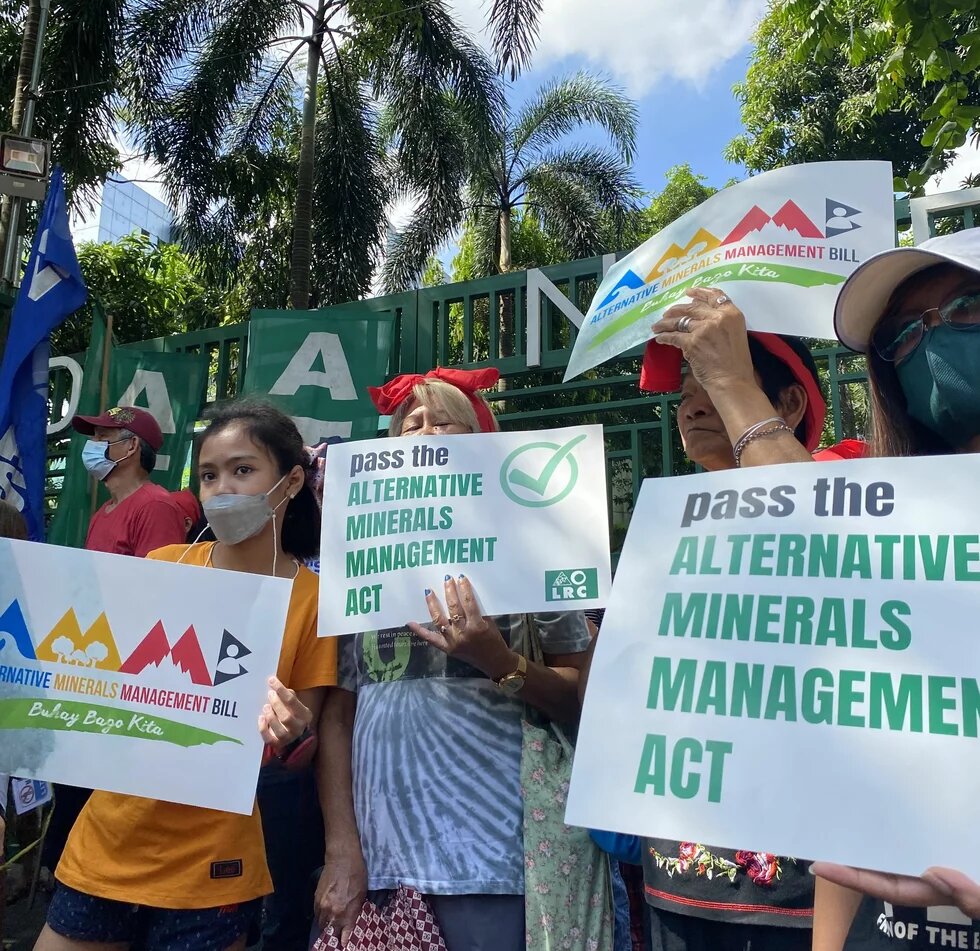
In terms of public policy, civil society groups and communities have banded together around counterproposals to the 1995 Mining Act, such as the Alternative Minerals Management Bill and the People’s Mining Bill. These bills emphasize expanding the list of no-mining zones, promoting local autonomy over natural resources governance, and prioritizing domestic use of mineral wealth. This includes the production of RETs for achieving the country’s Nationally Determined Contribution, where its energy mix is 50% renewable by 2050.
The bills concede the indispensability of mining, within reasonable ecological and social boundaries.
Local governments (the provinces of Occidental Mindoro, Palawan, South Cotabato, to name a few) themselves have issued moratoriums or no-mining ordinances, though this intervention has become tenuous. In the words of the environment ministry official, the government is “strengthening the protection of mining investments from unilateral adverse policy shifts, such as retroactive amendments to local ordinance, including zoning restrictions, bans on certain mining methods, or arbitrary changes to fiscal regimes.”
The recent decision of the Supreme Court to strike down an ordinance imposing a mining moratorium in Occidental Mindoro reveals a challenging legal landscape. In the province of Nueva Vizcaya, a local court issued a temporary restraining order on a community barricade against a mining operation, which the former denied having consented to in the first place.
Alternatives to extractivism will have no fans in developing nations bent on growing their economies by any means. Mining, including transition mining, is not only tempting, but familiar. The commoditization of natural resources has always been a developing nation’s crutch—and curse, where benefits overwhelmingly accrue to companies or corrupt officials, leaving a country no less poor than it was. The project of enclosure is nowhere finished in the Philippines, and powerful forces will not rest until the commons are colonized.
Creating alternatives to extractivism
Alternatives to extractivism consolidate communities and local governments that protect the environment, livelihoods, or customary lifeways. Extractivismo is especially cogent as a critique since extractive projects are often economic enclaves which are disconnected from the national economy.
Resistance is tenable if communities are organized. However, there are places with almost no recourse to justice, areas where the government has “high discretion and low accountability”. It is these places that will require a surfeit of solidarity.
Although enabling policies are locked in place, the country’s long history of environmentalism means the fight against mining is far from over. Aware that alternatives necessitate ‘not pure departure’ but engaging with existing tensions, the following are some of the ways that movements can wrestle with extractivism.
Solidarity groups should still work at reforming mining policies. This includes pushing for a comprehensive inventory of the country’s mineral resources and to square that against the country’s needs, whether for industrialization, or the transition.
The government must be compelled to come up with a strategic environmental assessment (SEA) that computes risks from environmentally critical projects in a holistic fashion, departing from the myopia of the piecemeal assessments required by law. Ally local governments will need to craft land use plans demarcating protection from production areas, for example.
For communities, indigenous peoples’ free, prior and informed consent (FPIC) can be further strengthened by the ‘Right to Say No’ concept, which rails against the colonial marketization of the environment and assumes indigenous resource sovereignty.
Communities must able to sustain their lifeways or explore forms of thriving within or at the edge of these projects. Many more creative alternatives can be invented. What is vital is the transformative nature of these alternatives, to remake “sociospatial ordering and create space for counter-territorialisations”.
Promoting the habitability of places
One such epistemic jump-off point for alternatives to extractivism is the notion of habitability, as distinct from the more mainstream lens of sustainability. Habitability is anchored on the relationship that unfolds between a community and a place, impacting people’s ability to lead lives with dignity. Habitability can be viewed as a spectrum where at one end is a socio-ecological system which allows human flourishing and at the other, one which denies it.
The 1995 Mining Act declares that “mineral resources in public or private lands, including timber or forestlands as defined in existing laws, shall be open to mineral agreements…” Habitability complicates the availability of space for extractives and resists the transmutation of nature as no more than a source of raw materials.
Frontline communities will be the most effective acolytes of habitability, forming what Thea Riofrancos calls a “politically potent attachment to what has not yet been lost.”
__
Maya Quirino is a non-profit worker who traces her roots to the Higaonon indigenous people, in Bukidnon, Philippines.
Disclaimer: This published work was prepared with the support of the Heinrich Böll Stiftung. The views and analysis contained in the work are those of the author and do not necessarily represent the views of the foundation. The author is responsible for any liability claims against copyright breaches of graphics, photograph, images, audio, and text used.


