
Article
Music and art have long been a refuge for those most marginalized, and in Southeast Asia they now fuel a new wave of women and queer artists shaping their own resistance. The stories of the artists covered in this article reveal how sound carries memory, defies toxic normativity, resists oppression, and builds community in scenes that rarely welcome them. Their perseverance and resilience through their art show how artivism turns everyday struggle into power, connection, and a collective path toward liberation.

When art carries a cause, it becomes unstoppable. Activists have long used art as an expressive medium to advocate for marginalised communities and drive social change. This merging of artistic practice and activism is frequently referred to as “artivism,” a concept that can be traced back to the 1990s when Chicana/o artists in Los Angeles and Zapatista community members from Chiapas, Mexico, used theatre, murals, and music to protest neoliberal policies, systemic racism, and environmental destruction. Since then, the idea has moved across borders, taking on new meaning in liberation struggles from Black Lives Matter to pro-democracy uprisings, where artists use creativity to confront state power and keep community memory alive. Artivism has continued to gain ground in the 2020s as movements recognise the power of accessible, art-driven advocacy. In Southeast Asia specifically, artists now use music, performance, and visual culture to speak to censorship, authoritarianism, and the fight for self-determination, setting the stage for how art shapes current political debates in the region.
Many artists share a commitment to challenging restrictive norms around gender and sexuality and to creating space for people whose identities are often marginalised or controlled across the region. Notable artivists include Sawangwongse Yawnghwe, a Myanmar-born, Netherlands-based painter who protests the persecution of the Rohingya, and Ahmad Zakii Anwar, a Malaysian artivist who founded one of Malaysia’s first shelters for AIDS patients in 1994. In literature, Filipino lesbian writer and Palanca Award winner Jhoanna Lynn Cruz gained attention for Women Loving: Stories and a Play (2010), a work highlighting lesbian identity and experience. She remains one of the few Southeast Asian writers actively increasing visibility for queer women in literary spaces and the public.
Thailand is also home to grassroots activists using art and writing to make information accessible. Nut Rock Boonsom, author of the webtoon I Am a Trans Boy (2024) and a member of the TRAns Man Peers (TRAMP) team, and Baphoboy, a Thai satirical artist from Chon Buri and graduate of the Faculty of Painting, Sculpture and Graphic Arts at Silpakorn University, both use their platforms to advocate for social justice issues close to their hearts. Together, their efforts point to a broader wave of innovation that now extends into electronic music, where a new generation is turning sound into a tool for resistance.
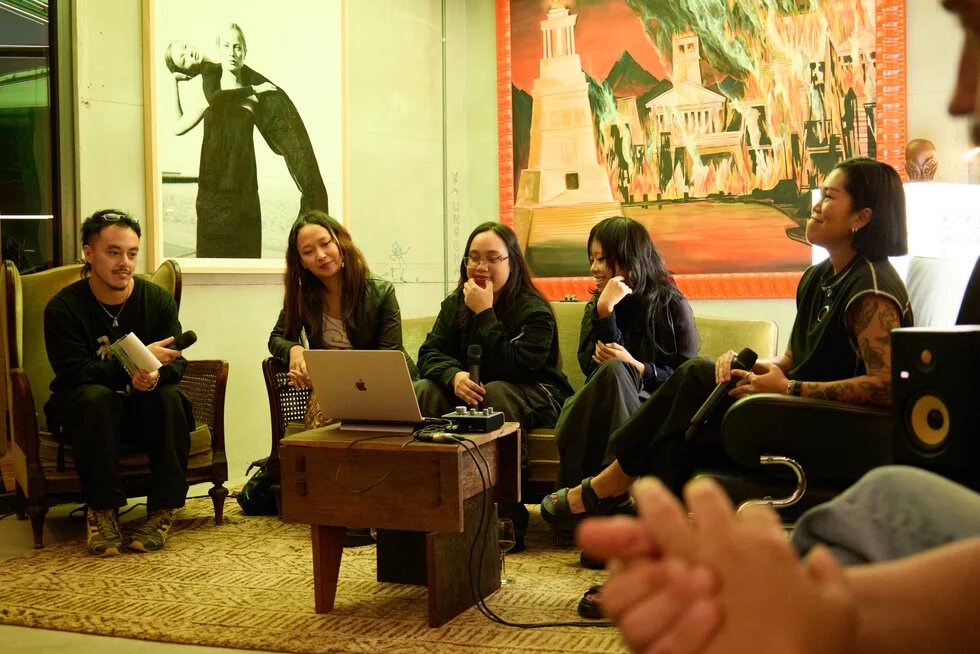
Heinrich Böll Stiftung aims to highlight women and queer artists from Southeast Asia who use their platforms and art to build communities that welcome underrepresented identities in music. NON NON NON is a women and queer collective founded by DJ Mae Happyair that Heinrich Böll Stiftung has collaborated with in the past. Since 2023, the collective and the foundation have worked together on workshops, such as “Intro to DJ-ing Workshop for Women and Non-Binary”, and public programs that center gender justice and creative freedom in electronic music. NON NON NON and Heinrich Böll Stiftung most recently came together to host “Voice Unmuted: Amplifying Women and Queer Artists in Southeast Asia Through Sound Design,” a public event in Bangkok that highlighted the efforts of women and queer electronic music producers who are using their artistic practice as a vehicle of self-expression and political commentary.
“Voice Unmuted” brought together artists from Thailand, Vietnam, Myanmar, Malaysia, and Singapore to share original electronic music inspired by their own stories and daily experiences. The panel and performances featured Mae Happyair, LnDH, rEmPiT g0dDe$$, CHAULICHI, and Sketch.
The audience, many of whom struggled to stay still while listening, first heard a collaboration between LnDH and rEmPiT g0dDe$$ titled “ចាំតិច”, pronounced “cham tik,” which means “wait a little.” LnDH, who lives in Cambodia, wanted to use traditional Cambodian musical elements to honour the scene in Phnom Penh and blend them with the rhythms of Reggaeton and drum and bass. Both artists agreed that drawing from the musical heritage of Cambodia, the country they currently live in, lets them show respect for local traditions and create with clear intention.
Both artists noted that working with other queer and women artists builds genuine, sustainable networks of collaboration that help artists support each other as they grow. This strengthens the sustainability of the community and the art form by creating stability, reducing isolation, and giving emerging artists a support system, they can rely on. In a heavily male-dominated industry, having strong bonds with other artists also leads to real knowledge sharing. One artist can offer advice and insight on something they’ve handled before, while another is struggling with the same issue.
These networks are serving a crucial function for artists who remain overlooked by the music industry. rEmPiT g0dDe$$, for example, noted that in the ten years she’s been in the industry, she still hasn’t seen women and queer artists being booked for genuine reasons rather than as token hires, especially on the global stage. Booking managers, promoters, and leadership in the music industry still refuse to acknowledge how often women and queer artists are treated as token additions rather than valued contributors. LnDH, whose daily life is shaped by systemic oppression and navigating borders, describes her art as an act of survival. The other artist in the duo, rEmPiT g0dDe$$, who also faces visa issues, financial strain, burnout, and displacement, sees her art as a way to reclaim emotional autonomy and “a place where these pressures alchemise into sound.”
CHAULICHI, who is from Vietnam, shared her track “Unexplained”. She described it as being full of raw emotion and directly inspired by the event’s theme of unmuted voices. For her, music lets her express what she feels, especially the feelings she usually hides. She created the track in her apartment beside a busy street in Saigon, where she could hear traffic and karaoke drifting in. That chaos runs through the track, “it’s quiet and beautiful, but noisy and powerful at the same time”.
For CHAULICHI, being part of the event was a way to voice the pressure she carries as a woman navigating a scene that sidelines her. She felt more powerful and inspired within the community, but back in Saigon, she didn’t feel seen in a male-dominated space. She said her first DJ gig with NON NON NON, during a collaboration with SYS Sister Sounds in Bangkok in 2023, a project ongoing since 2021, was a turning point because it strengthened her sense of purpose. Born in a small village in Hue City, her move to a large city became the moment she broke away from the norms expected of women. That oppression later shaped how she connects with her audience through organic instrumentation and sounds from home that surface in her music. Her ideal world is a music industry that not only includes underrepresented communities but also turns artists who come from the harshest experiences into the majority. She describes herself as “a small dot in the middle of the rushing water”, which is represented in her multi-sensory art form.

The fourth artist on the panel, and founder of NON NON NON, Mae Happyair, described her track “A Child” as a way to heal from her childhood, when she was separated from her parents and grew up with her grandparents in a remote area of Thailand. As it played, she looked proud, sharing small laughs with the other panellists, swaying to her beats. When Mae started NON NON NON, she drew inspiration from living with multiple layers of difference and holding several identities. “I’ve been rejected from many opportunities since I was young, and I always knew I had something to give, so instead of waiting to be chosen, I built spaces for myself.” By creating the space to find community and opportunities, her collective became “a space that attracts people who share the same values. Everyone shows up with intention, working hard in their own way.” That energy is what she wants to support and keep alive.
Building a community founded on the principles of inclusion, shared care, and collective uplift means setting aside other priorities, including her own growth, which she says she’s “set aside for too long, even though it’s a core part of everything I do.” She sees the community expanding as a new generation of queer artists brings fresh stories into Bangkok. She’s not just proud of it, she “truly admires” it. She hopes NON NON NON won’t be the only space in the spotlight, noting that there are still “subtle limitations” despite how open the scene may look. Her role continues evolving, supporting upcoming artists while giving her own artistic voice space to grow.
These values shape how she approaches music. She notes that she’s “always searching for equality.” “Music empowers me because it lets me show the complexity of what I believe in, and keep pushing toward the world I want to see,” a sentiment shared by many other artists on the panel. Her relationship with her art is a two-way street: “A track might make you dance, but for me it’s the message I’m sending out. The energy on the dancefloor comes back to me, track after track, a conversation in motion.” Her resilience is a strong commitment to the scene and her art.
The final artist featured at the event is SKETCH, with a track called “Dawn,” which is accompanied by a music video she created. The Singaporean-born DJ uses a crow in her visual imagery; a bird often misunderstood, feared, but highly adaptable. As a Malay Singaporean, she incorporates sounds of Southeast Asian music cultures like gamelan into her music, which are familiar to her but might not be to the audience Through her music, she constantly rediscovers her culture as a Malay Singaporean, with certain percussion pulling her “back to the origins of those sounds.” She strongly believes a more inclusive music industry needs “a line-up that’s truly diverse, more women headliners, and more grassroots events uplifting women and non-binary artists.”
Like many women artists, she faces critiques such as “doing it wrong,” which she refuses to accept, choosing instead to have fun. She notes that these critiques “wouldn’t be thrown at a cis male artist, and I try not to let it undermine me.” As an artist, she sees herself as a facilitator, “shifting the energy, bringing the room up and down together,” echoing Mae’s emphasis that it’s a two-way street. Her Malay roots remain strong, and she hopes to “lift up my Malay homies.” After being underestimated for so long, self-esteem and belief in oneself can be diminished. She believes it’s time to “relearn and recreate,” this time “with more love for ourselves than ever before.”
Now more than ever, the world needs activism in an accessible form. These artists show that art can be that language, helping underrepresented communities connect, amplify their own voices and others’, and share their stories and emotions. As Southeast Asia’s nightlife continues to grow, so too will the visibility of these artists and their voices. But will the global scene adapt, or will those in power continue to tokenize? That remains to be seen.
Listen to all music tracks, please click here, which are available for free download; an opportunity to support, reuse, and spread these unmuted sounds of women and queer communities, memory, and collective resilience.
__
Shane Bhatla (he/they) is a non-binary disabled activist and Gender Equality, Diversity, and Social Inclusion (GEDSI) consultant. Shane’s advocacy focuses on trans and disability issues, working to destigmatize conversations about mental well-being in these communities.
Disclaimer: This published work was prepared with the support of the Heinrich Böll Stiftung. The views and analysis contained in the work are those of the author and do not necessarily represent the views of the foundation. The author is responsible for any liability claims against copyright breaches of graphics, photograph, images, audio, and text used.


