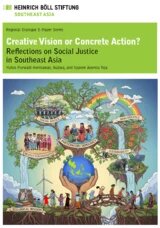
This E-paper examines the longstanding tension between ASEAN’s creative vision and its limited concrete action in promoting social and environmental justice across Southeast Asia. While social justice has been foundational in the national constitutions of Southeast Asian countries since independence, inequalities persist. The authors highlight that despite constitutional commitments to equitable access, fundamental freedoms, and non discrimination, as seen across Indonesia, Vietnam, Malaysia, the Philippines, and others, realities on the ground reveal enduring disparities in wealth, opportunities, and rights protections.

ASEAN has invested heavily in crafting a normative architecture for justice. Key documents, from the 1967 Bangkok Declaration and ASEAN Concords to the ASEAN Charter, Human Rights Declaration, and the ASEAN Socio-Cultural Community (ASCC) Blueprint 2025, signal strong commitments to equality, poverty reduction, and inclusive development. Environmental justice has also gained prominence through agreements such as the 1985 ASEAN Conservation Agreement, the 2007 Declaration on Environmental Sustainability, and most recently the 2025 ASEAN Declaration on Environmental Rights. These declarations establish wide ranging aspirations: equal access to opportunities, environmental protection, public participation, and strengthened rights.
However, the paper emphasizes that these frameworks have not translated into meaningful change. Data presented in the report, including GDP per capita disparities on page 29, poverty levels on page 30, and gender gap rankings on page 32, illustrate significant unevenness in development. Cambodia, Laos, and Myanmar continue to struggle with high poverty and low literacy rates, while income inequality persists in Indonesia, Cambodia, and Laos. Women remain underrepresented in parliaments and decision making spaces, as shown in Table 6. These indicators highlight how structural barriers continue to undermine ASEAN’s vision of shared prosperity and rights for all.
Environmental justice faces similar shortcomings. The paper notes that despite ASEAN’s new Declaration on Environmental Rights, major challenges persist, including weak enforcement, limited public participation, restricted access to information, and threats to environmental human rights defenders. Table 2 on page 21 to 22 details these gaps, revealing unresolved issues such as transboundary haze, deforestation, poor environmental governance, and exclusion of Indigenous rights. The authors argue that environmental justice, essential for addressing climate risks, displacement, and resource conflicts, is still insufficiently embedded in ASEAN’s social justice agenda.
Ultimately, the paper concludes that ASEAN’s strength in vision building must be matched by institutional reforms and concrete action. The authors recommend establishing a Special Commission on Social Justice, enhancing collaboration with development partners, building a regional civil society hub, and accelerating the implementation of the new Environmental Rights Declaration. Only through stronger institutional capacity, accountability, and inclusive participation can ASEAN bridge the widening gap between rhetoric and reality, and move toward a genuinely people centered community that delivers social and environmental justice for all.
Key Takeaways
- ASEAN has been highly creative in articulating visions of social and environmental justice, producing numerous declarations, frameworks, and blueprints since 1967—but implementation continues to fall far short of these ambitions.
- Despite long-standing constitutional commitments to social justice across Southeast Asian countries, structural inequalities persist—manifested in poverty, illiteracy, gender inequality, and uneven development between member states.
- Environmental justice remains insufficiently integrated into social justice frameworks. Even though ASEAN has recently strengthened environmental commitments—including adopting the 2025 ASEAN Declaration on Environmental Rights—major gaps in execution, transparency, and protections remain.
- A significant gap exists between ASEAN’s rhetorical commitments and concrete action, driven by weak institutions, inadequate coordination, and limited mechanisms for enforcement, public participation, and rights protection. Stronger institutional capacity and civil society engagement are urgently needed.
The E-Paper can be accessed from this link