
Article
Thailand is at the forefront of becoming a regional technology hub, fueling a wave of investment in hyperscale data centers. However, like all development, this comes with costs. The question is not a simply who will benefit from a high-tech innovation-driven ecosystem, but whether Thailand can balance those benefits with the need to protect its fragile water resources and address growing climate and environmental impacts.

One of the biggest stories to emerge in Thailand since the beginning of 2026 has been the wave of investment in hyperscale data centers. The trend has brought both strong support and opposition, prompting intense debate across the media. Supporters come from various groups, including those who genuinely believe that these investments will help transform Thailand’s economy from conventional manufacturing into a high-tech innovation-driven ecosystem, as well as those who stand to benefit directly from the investment, such as the landowners, industrial estate operators, construction companies, and related businesses.
As the debate continues, a wide range of views and opinions are being expressed, often shaped by different interests and perspectives. Amid the overwhelming information, it is crucial to understand the broader implications of hyperscale data center development for Thailand’s economy, society, and environment, particularly its valuable water resources. It is remarkable to witness the transition of technology. AI-driven innovation is reshaping industries, creating opportunities that many believe will drive growth. However, it is also important to understand the costs of such breakthroughs.
Part 1: Implications for Development
Investment in hyperscale data centers has become one of Thailand’s new hopes for revitalizing economic growth (Skidmore 2026). Since these centers are the backbone of cloud technology and national data infrastructure, these facilities are expected to support AI technologies that could transform everything from logistics and healthcare to e-commerce, banking, and everyday life. The government’s ambition is for the country to become a regional digital infrastructure hub, attracting skilled engineering jobs, fostering homegrown technological innovation, and boosting digital services for businesses. The need for such investment is clear. However, as Thailand races to establish itself as a regional hub, a question remains: is the promise worth the potential consequences? Greater attention must focus on the communities, resources, and ecosystems that may be affected over the next 20 years.
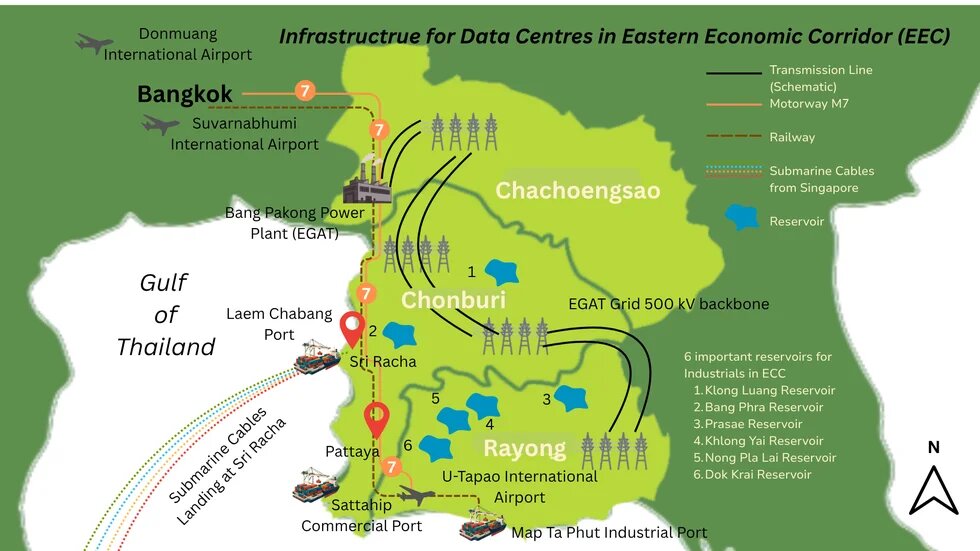
At the heart of this transformation is the Eastern Economic Corridor (EEC), which spans the provinces of Chonburi, Rayong, and Chachoengsao (EECO 2025). Policymakers and global technology companies have chosen this region for several reasons. First, its deep-sea ports and airport, together with the planned high-speed rail link to Suvarnabhumi International Airport, highlight its international connectivity.
Sri Racha in Chonburi province will serve as a gateway for Southeast Asia's internet. The district hosts landing stations for major submarine cables, including the Asia-Africa-Europe (AAE-1) and Asia Direct Cable (ADC), linking Thailand directly to regional connectivity hubs such as Singapore. Its established industrial base and access to the power grid have also made it an attractive location for hyperscale data centers, although constraints in electricity transmission infrastructure, including the availability of the substations, remains a challenge.
Most importantly, data centers demand not only huge electricity loads but also substantial volumes of water supply. The region is already balancing the competing water demands of agriculture and manufacturing, particularly during the dry season. Water is supplied by both reservoirs in Rayong and Chonburi provinces, including Bang Pra, Dok Krai, Nong Pla Lai, Khlong Luang, and Prasae Reservoir. Additional supplies are drawn from the neighboring river basins, such as the Bang Pakong River Basin in the eastern region and the Pasak River Basin managed by both public and private water utilities.
At first glance, everything is in place. Yet, the reality may be more complicated. Before examining the potential negative impacts of these investments, it is worth considering whether the benefits envisioned by the government are indeed promising as they seem. What if some of these claims are little more than marketing narratives promoted by those who stand to profit the most? Since most hyperscale data center projects are owned by foreign companies, a key question is whether the highly skilled engineering jobs they create will primarily benefit Thai workers. Moreover, data centers require relatively few employees to operate and therefore may not generate local employment on the same scale as conventional industry.
Second, data centers have limited relevant to most tech startups or digital services businesses, since relatively few applications in Thailand currently require a low-latency connection to the nearest server, such as IoT (Internet of Things). This means that, as long as there are data centers in the region, these businesses do not need to be based in Thailand. So, what benefits do Thai people actually get from these investments?
Job creation is indeed there, but only for a short time – during the construction period. The construction sector sees significant growth from the investment (The Nation 2026). The figures some parties have used to claim positive outcomes in the media are actually from activities during the construction period, which normally lasts only one to two years, depending on the size of the project. Some even brought up concepts such as data sovereignty to support their argument.
This wave of investment brings a dilemma: how can Thailand safeguard its data sovereignty without jeopardizing local water security? Data sovereignty keeps citizens’ digital lives, financial records, and government data safely within national borders, shielded by local laws. Yet, the infrastructure required for this protection consumes vast public resources. While the nation reaps economic rewards and tighter tech control, local communities shoulder the burden of expanded industrial land, soaring electricity consumption, and intensified water extraction. Is this a fair exchange? Policymakers have to strike the right balance for all Thais.
While the neighbors provide significant lessons in balancing digital infrastructure growth and resource management, particularly through their own regulatory responses to data center expansion, Singapore offers a notable example. Their government temporarily halted the approval of new data center projects when increased strain on water and power infrastructure became apparent. In response, Singapore implemented regulations that strictly mandate the use of highly treated reclaimed water for data center cooling (IMDA August 2026).
This policy both eases pressure on the potable water supply and enforces a circular resource-use framework. Another lesson is from Johor, Malaysia, where data center development spilled over from Singapore. Operators are required to use reclaimed water and invest in dedicated industrial water infrastructure to protect local aquifers from depletion.
Back in Thailand, the current approach lacks the anticipatory regulations seen in its neighbors. Consequently, significant hyperscale data center projects have already been built without adequate regulations to govern them, reducing transparency and accountability and highlighting the need for prompt, inclusive regulatory interventions. Relying on legislation and policy reform only after resource stress emerges may no longer be sufficient to address this problem. We need regulations that protect people, before such projects are constructed.
Part 2: Water-Related Impact
The main issue with hyperscale data centers is how they handle heat. Servers process huge amounts of data and convert almost all the electricity they consume into heat (Tian et al. 2022), which must be constantly removed to avoid hardware failure. A typical hyperscale campus covers 10 to 20 hectares and uses between 50 and 200 megawatts of electricity. In a country where regulations on data center operations are still evolving, most operators use evaporative wet-cooling towers because they consume less energy than closed-loop chillers, which are generally considered more expensive. However, this gain in energy-efficiency comes with significant water demand.
A typical hyperscale data center can consume millions of cubic meters of fresh water annually, comparable to the water consumption of a small town. Critically, data center cooling towers require high-purity, demineralized water, rather than standard municipal water because impurities, such as minerals and dissolved solids, can accumulate and cause scaling and corrosion within the machinery (Chien et al. 2012). This cooling process generates large volumes of wastewater, progressively reducing the amount of usable water available in the local supply.
Thailand’s current regulatory framework has major gaps that put the EEC at risk of resource shortages (OECD 2022; TDRI 2024). Data centers have typically been classified as a ‘Warehouse’ rather than as heavy industry or utilities, allowing many of them to avoid mandatory Environmental Impact Assessments (EIA). This is because data centers are generally not considered to release toxic chemicals, unlike factories; their primary waste streams consist of hot air and mineral-rich water from cooling systems.
During the dry season, this cooling-related water consumption threatens the availability of water for farmers who depend on reliable supplies to cultivate crops such as durian and rubber. As described in the first part of the article, the industry relies not only on reservoir supplies but also on water from the other river basin. The competition for water in the EEC is therefore likely to intensify as demand continues to rise.
Thai authorities recognize this issue and are trying to safeguard water security while laying the foundation for economic expansion by pushing ahead with the 7.2-billion-baht Khlong Wang Tanod Reservoir in Chanthaburi (Royal Thai Government 2026). Following Cabinet approval, this key infrastructure initiative will irrigate over 87,700 rai (14,032 hectares) of farmland while delivering a reliable water supply for local households, agriculture, industrial operations, and the EEC. The concern, however, is that this water supply depends entirely on rainfall.
What if a severe drought lasts a long time and makes the water supply insufficient? The region would remain highly vulnerable to water insecurity. Not to mention that, in addition to consuming large amounts of water, these massive data center campuses could also change the local climate and water cycle. When natural vegetation and soil are replaced by concrete, asphalt, and reflective roofs, the albedo effect, or the ability of a surface to reflect the solar radiation, changes. As a result, these surfaces absorb heat during the day and release it at night, affecting the local temperatures.
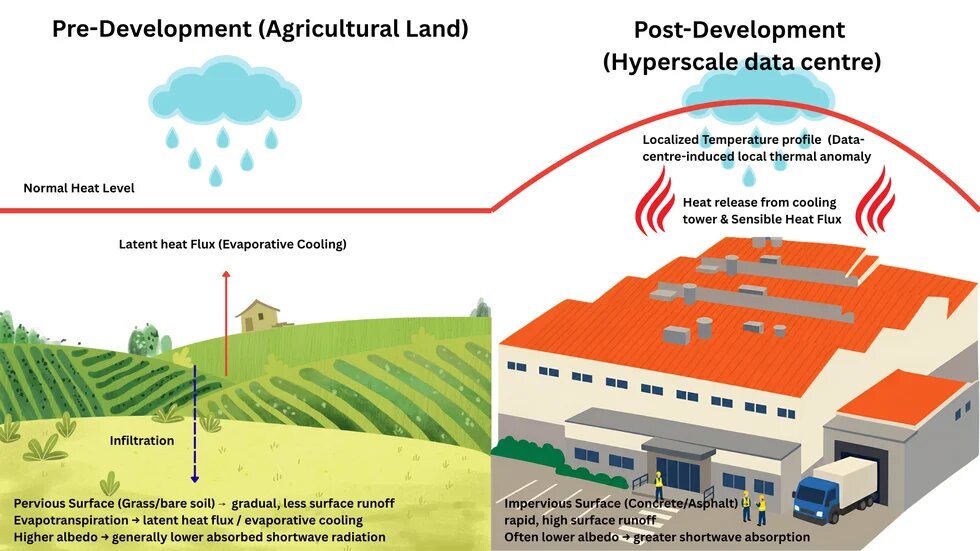
These developments also change how water moves through the land. When natural land is paved for data centers, engineers build large ponds and drainage networks to handle heavy rain, often planning for rare, extreme storms (Martinez 2026). While these systems prevent flooding, they also hasten the drainage of rainwater from the area. In addition, natural landscapes are replaced by roads and concrete pavements, reducing water infiltration limiting groundwater recharges. This dries out the soil, reduces natural cooling, and warms the area. Combined with hot air from cooling towers, this creates a ‘Heat Island’ effect, raising local temperatures, lowering humidity, and making heat stress worse for nearby communities (Marinoni et al 2026).
Making Thailand a leading digital hub is a valuable step for the country, but it comes with long-term challenges that require robust new regulations. The benefits of cloud technology and AI should not come at the cost of depleting local water supplies or harming communities and their environments.
To achieve equitable outcomes, Thai policymakers need to close regulatory gaps by establishing strict water-use standards and requiring comprehensive environmental impact assessments for all large data center projects, especially hyperscale facilities.
Future project approvals should require closed-loop cooling systems and the use of reclaimed industrial water instead of public water supplies.
However, it may be argued that imposing these additional requirements could raise capital and operating costs, potentially discouraging foreign investment or slowing the pace of digital infrastructure development. Nevertheless, these requirements cannot be relaxed simply to attract investment at the expense of precious natural resources in an era of increasing climate vulnerability. Therefore, while prioritizing environmental protection, policymakers must also consider strategies that maintain national competitiveness and continue to attract investment. By carefully balancing technological expansion with environmental protection, Thailand can still reduce the impacts on communities and avoid ‘building a fence after the cow is lost’* as has too often been the case.
*A Thai idiom sharing the same meaning as ‘Shutting the stable door after the horse has bolted.’
___
Kwankamol Chittrakul is a Civil and Water Engineer specializing in water resources management, flood risk assessment, and sustainable water infrastructure. Her expertise spans hydrological and hydraulic modelling, stormwater management, flood routing, detention systems, and catchment-scale risk assessment.
Disclaimer: This published work was prepared with the support of the Heinrich Böll Stiftung. The views and analysis contained in the work are those of the author and do not necessarily represent the views of the foundation. The author is responsible for any liability claims against copyright breaches of graphics, photograph, images, audio, and text used.
References
"About EEC Development Fund." https://www.eeco.or.Th/En/About-eec-development-fund/. 2025. https://doi.org/https://www.eeco.or.th/en/about-eec-development-fund/.
“IFC Urges Thailand to Turn Data Centre Investment into Jobs.” nationthailand, September 10, 2026. https://www.nationthailand.com/business/economy/40070862.
Chien, S. H., M. K. Hsieh, H. Li, J. Monnell, D. Dzombak, and R. Vidic. 2012. “Pilot-Scale Cooling Tower to Evaluate Corrosion, Scaling, and Biofouling Control Strategies for Cooling System Makeup Water.” Review of Scientific Instruments 83 (2): 025109 (or https://doi.org/10.1063/1.3680563).
Domec, Jean-Christophe, John S. King, A. Noormets, E. Treasure, M. J. Gavazzi, G. Sun, and S. G. McNulty. 2010. “Hydraulic Redistribution of Soil Water by Roots Affects Whole-Stand Evapotranspiration and Net Ecosystem Carbon Exchange.” New Phytologist 187 (1): 171–183. https://doi.org/10.1111/j.1469-8137.2010.03245.x.
Marinoni, Alessandro, Pietro Liò, Erik Cambria, Leonardo D. Zilio, Wei Lin, Marco D. Mura, Jocelyn Chanussot, et al. 2026. “The Data Heat Island Effect: Quantifying the Impact of AI Data Centres in a Warming World.” arXiv preprint. https://doi.org/10.48550/arXiv.2603.20897.
Martinez, J. 2026. “Data Centre Detention Pond Sizing Fundamentals.” RSP Engineers. https://rspengineers.com/civil-engineering-blog/data-center-detention-p….
MGR Online. 2026. “Data Centre Chanan Suek ‘Nam–Fai–EEC’: Chumchon La Chue Tan Wan Thapwayakon Thuk The Hai Ut” [Data centres ignite battle over “water-power-EEC” as communities protest resource diversion]. August 28, 2026. https://mgronline.com/stockmarket/detail/9690000084740.
The Nation Thailand. 2026. “The True Price of the Cloud: Inside Thailand’s Battle for Water and Power.” September 1, 2026. https://www.nationthailand.com/business/tech/40070483.
Skidmore, Zachary. “Thailand Set to Finalize New Data Center Regulations by Mid-October - Report.” All Content RSS, September 18, 2026. https://www.datacenterdynamics.com/en/news/thailand-set-to-finalize-new….
“Singapore Launches World’s First Liquid Cooling Standard for Data Centres in Tropical Climates.” IMDA. August, 2026. https://www.imda.gov.sg/resources/press-releases-factsheets-and-speeche….
Tian, Ming, Haifeng Zhang, Hongyu Wu, and Ming Tian. “Energy Management for Data Centre Microgrids Considering Co-Optimisation of Workloads and Waste Heat.” IET Energy Systems Integration 4, no. 1 (2022): 43–53. https://doi.org/10.1049/esi2.12044
Thailand Development Research Institute (TDRI). “Talking about Water on World Water Day: Sustainable Water Management in the Eastern Region.” 2024.
OECD. Managing and Financing Water for Growth in Thailand: Highlights of a National Dialogue on Water. OECD Studies on Water. Paris: OECD Publishing, 2022. https://doi.org/10.1787/839a4f70-en
Royal Thai Government. “Approval for Implementation of Khlong Wang Tanod Reservoir Project, Chanthaburi Province.” August 5, 2026.


