Article
ASEAN pulled off a deft diplomatic performance at its final summit for 2025, combining seemingly conflicting initiatives – such as hosting Trump and getting to know Brazil's Lula and South Africa's Ramaphosa – under its wide, welcoming tent. Timor-Leste is finally a full ASEAN member. But the regional grouping goes into 2026 with pending issues like Myanmar and the Thai-Cambodia conflict as well as questions about how the Philippines, the next ASEAN chair, will manage discussions around the South China Sea disputes.

The Trump show barrelled into town and hogged many headlines during the ASEAN summit in October 2025. But for ASEAN, the real main act was its formal admission of Timor-Leste – a country whose brutal 24-year occupation by Indonesia was a touchy issue that Southeast Asian governments used to tiptoe around.
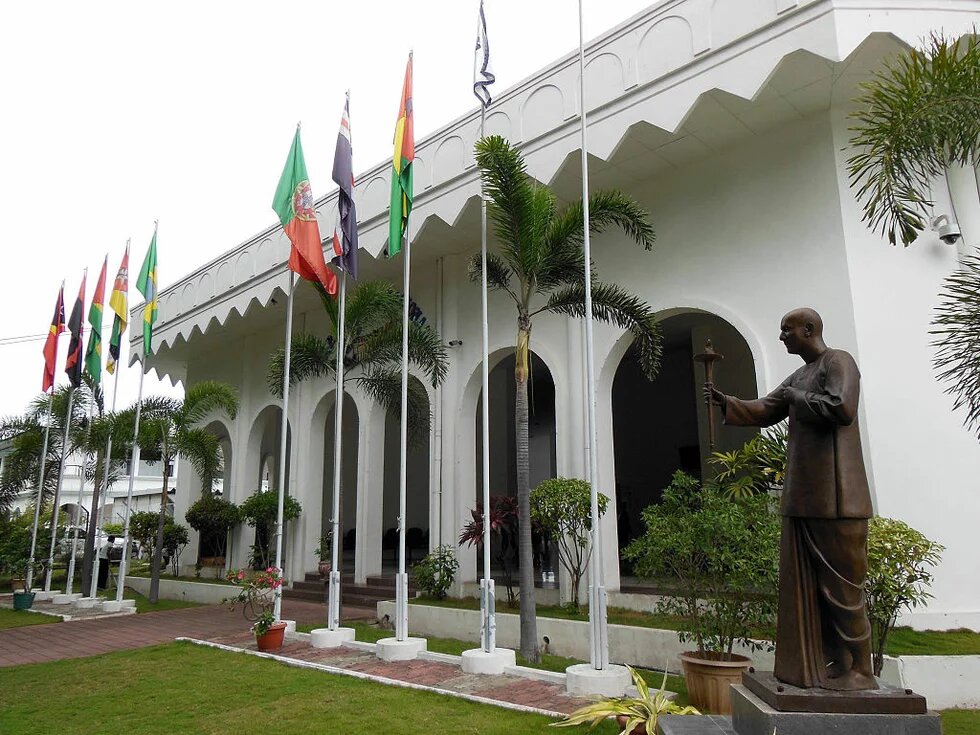
So when Timor-Leste’s black, yellow, red and white flag was placed between that of Thailand and Vietnam on 26 October at the ASEAN leaders’ summit in Kuala Lumpur, it was so much more than the bureaucratic approval of an application the country made 14 years ago.
It is a major point of closure for Timor-Leste as well as Indonesia, against the backdrop of the troubled, violent history between these neighbors, now co-equal peers in ASEAN. Timor-Leste’s entry brings all of the 11 countries located in Southeast Asia into the ASEAN fold – nearly six decades after the regional club was formed in 1967.
Indonesia’s occupation of what was then called East Timor, which it invaded in December 1975 and annexed as a province, resulted in the deaths from military action, starvation or disease of 200,000 people or more – up to a third of its population of 600,000 before troops were sent in by former dictator Suharto. This invasion came days after East Timor proclaimed independence in November 1975, just months after Portugal pulled out from its colonial territory on the eastern half of Timor island.
Timor-Leste became a sovereign nation in May 2002 after a period of United Nations-led transition, completing a process that began after its people voted for independence in a UN-run referendum under Suharto’s successor in 1999.
Timor-Leste Prime Minister Xanana Gusmao, the 79-year-old former leader of the guerrillas who fought Indonesian rule and spent years in an Indonesian jail, wiped off some tears after Prime Minister Anwar Ibrahim, speaking for Malaysia as ASEAN chair for 2025, welcomed his country of 1.4 million people into the regional club.
“For the people of Timor-Leste, this is not only a dream realized but a powerful affirmation of our journey, one marked by resilience, determination and hope,” Gusmao said.
“Joining ASEAN completes our diplomatic engagements — with the United Nations, the WTO and other international institutions. The missing link was ASEAN,” said Timor-Leste President Jose Ramos-Horta, who had lobbied his homeland’s cause from exile during Indonesia’s occupation and received the Nobel Peace Prize in 1996 for his efforts.
Indonesia – along with Malaysia – has been among the biggest champions for Timor-Leste's entry into ASEAN.
“Its space here completes the ASEAN family, reaffirming our shared destiny and deep sense of regional kinship. Within this community, Timor-Leste’s development and its strategic autonomy will find firm and lasting support,” said Anwar. “You said that it is easier to go to heaven than to be accepted by ASEAN,” he later recalled to Ramos-Horta, now 75.
“Timor-Leste’s story offers hope that regionalism may have the power to integrate and bring new opportunities for another country,” reflected Joanne Lin, senior fellow and coordinator of the ASEAN Studies Centre at the Singapore-based ISEAS-Yusof Ishak Institute.
For years, much of ASEAN’s discussion about Timor-Leste’s accession, including reservations by Singapore, was about technical issues – its capacity to handle membership responsibilities, the maze of ASEAN mechanisms and meetings and its logistical capacity to host summits in the future. Anwar pushed ASEAN to step up in supporting Timor-Leste so it could join it during Malaysia’s year as chair, saying the process had become “tedious”.
There has been much talk too about Timor-Leste’s challenges, such as poverty and its heavy reliance on oil. Its GDP in 2024 was 1,343.1 US dollars, slightly below Myanmar’s and half of Cambodia’s when it joined ASEAN in 1999, going by World Bank data.
But the country brings its own contributions to ASEAN. Ramos-Horta has talked of Timor-Leste’s experience with ending conflict, having had tribunals that looked into crimes against humanity, war crimes and genocide during Indonesia’s occupation. These give the country much more political weight than most ASEAN states in matters of democracy, human rights and peace.
At a time when majority of Southeast Asia’s nations are classified as autocracies in some shape or form, Timor-Leste is the only country listed without caveats as a “electoral democracy” in the 2025 Democracy Report by the V-Dem Institute.
“ASEAN is not a one-way street (of benefits for Timor-Leste). It also strengthens ASEAN itself,” Ivo Ribeiro, a Timorese fellow at the US-based National Bureau of Asian Research, said on the ‘StraightTalk Southeast Asia' podcast. “We bring fresh democratic energy and credibility. Timor-Leste is widely recognized as Southeast Asia’s most democratic nation.”
A day after his country joined ASEAN, Ramos-Horta offered to mediate in the civil war in Myanmar, soon entering its sixth year. Timor-Leste sees that it can contribute to the South China Sea disputes, drawing from its experience in negotiating maritime boundaries with its bigger, more powerful neighbour Australia. An observer in the Pacific Islands Forum, Timor-Leste can also link Southeast Asia with the Pacific.
Joining ASEAN brings three benefits for Timor-Leste, Ribeiro points out. First, accession gives it ‘diplomatic credibility’ as a country with political stability and good governance. Second, it opens the door to opportunities that come with ASEAN economic integration (even as it becomes a new market for the region of 700 million people). Third, Timor-Leste plugs into ASEAN mechanisms for cross-border cooperation to counter transnational threats, including illicit financial flows.
How Timor-Leste reaps these dividends depends on how it makes use of its membership. “Joining ASEAN is best understood as a policy lever, not a development guarantee. Membership alone with not guarantee success,” said Ribeiro.
Brazil and South Africa’s leaders come to town
Malaysia brought in two other new faces to the flurry of ASEAN meetings – Brazil’s President Luiz Inacio Lula da Silva and South African President Cyril Ramaphosa, who were the guests of the ASEAN chair.
Their first-time involvements with ASEAN push forward its trajectory of widening and diversifying relationships in today’s fractured international landscape, following the holding of the first ASEAN-Gulf Cooperation Council-China summit at the regional grouping’s first summit of the year in May 2025.
These also bore the stamp of Malaysia’s foreign policy what Anwar calls “active non-alignment” and its trademark affinity with the Global South, to which most of ASEAN states belong. Anwar had invited the two leaders at the BRICS (Brazil, Russia, India, China and South Africa) Summit in Brazil in July, where the Malaysian premier spoke of the need to build bridges between ASEAN and BRICS at a time of US unilateralism and the unravelling of the post-war global order.
Catching up in diplomatic ties, trade and investment connections with Malaysia and ASEAN were highlights of Ramaphosa and Lula de Silva’s remarks in Kuala Lumpur. Trade levels with Malaysia were “too low”, Ramaphosa said. Lula said Brazil’s current level of trade with Southeast Asian countries “means that we’re lacking a little bit of boldness from our business to and from our ministers”.
Both called for deeper ties between ASEAN and the regional groupings they belong to – Ramaphosa mentioned the Southern African Development Community (SADEC) and Lula, the Southern Common Market or MERCOSUR. South Africa is also chair of the G20 group of countries in 2025.
The two leaders’ visit “aligns well with the (ASEAN) regional goals to diversify their partnerships to avoid the risks brought by overdependency on a singular partner,” said Izzah Ibrahim, analyst at the Institute of Strategic and International Studies Malaysia.
“The attendance of the 2 Presidents marked the first time BRICS leaders joined ASEAN’s meetings in this way, signalling ASEAN’s growing outreach to the Global South,” Lin explained, with a shared focus on sustainable development, digital inclusion and energy transition. “ASEAN is signalling that it wants to move beyond being seen solely through the lens of US-China competition.”
With Malaysia “there has also been interest in values-based cooperation, such as with South Africa on the matter of Gaza,” Ibrahim added. Ramaphosa referred to South Africa and Malaysia’s “shared resistance to the atrocities of slavery and colonialism”, thanking Anwar for supporting his country’s genocide case against Israel at the International Court of Justice.
Reflecting South-South chemistry, Lula said Brazil would like to see Malaysia become the second ASEAN country after Indonesia to join BRICS. “Malaysia will have the support of Brazil to be a full member of BRICS,” he said at a press briefing.
Trump got his stage, expresses ‘100% support’ for Southeast Asia
ASEAN’s October summit also saw the return of US President Donald Trump, who along with Anwar witnessed the signing of a two-page declaration between Thailand and Cambodia on steps toward ending their border conflict.
Necessary or not, the 26 October ceremony was ASEAN’s formula for getting Trump to Southeast Asia. In it, Malaysia saw an opportunity for ASEAN to directly engage with the US president, who had only been to one ASEAN summit in 2017 (in his first term). Thus far, his administration’s view of Southeast Asia was as an arena for Chinese influence – and little else.
The US wanted the ceremony to highlight Trump’s role in ‘solving' the Thai-Cambodia conflict. It had asked for the signing event as a condition for coming to the ASEAN summit, the BBC reported. China – which also supported the July 2025 ceasefire agreement brokered by Malaysia – was not given a role in the ceremony.
Malaysia gave Trump the stage he wanted. But it walked a diplomatic tightrope between the space for political theatre and calibrating it such that the signing ceremony took place under the larger ASEAN tent – one that has always drawn a wide variety of leaders.
“Trump’s starring role at the peace accord was clearly choreographed for maximum visibility, and the absence of China did tilt the optics in Washington’s favour,” Lin said. “But it’s also true that ASEAN, under Malaysia’s chairmanship, played a careful game. Rather than ‘taking sides’, it prioritized keeping both powers invested in ASEAN’s processes.”
Lin added: “Given the history of US no-shows at ASEAN meetings, Malaysia and the bloc likely saw it (Trump being at the ceremony) as a pragmatic compromise – not ideal, but preferable to another empty seat.”
“In a sense, ASEAN gave Trump the stage but kept control of the script. It’s classic ASEAN diplomacy of being pragmatic,” she continued. “Finally, it was worth it” for ASEAN when Trump expressed his full, long-lasting commitment to the region, Lin added. Enthusing about his trip as an “amazing experience”, Trump said: “My message to the nations of Southeast Asia is that the US is with you 100 percent, and we intend to be a strong partner and friend for many generations to come.”
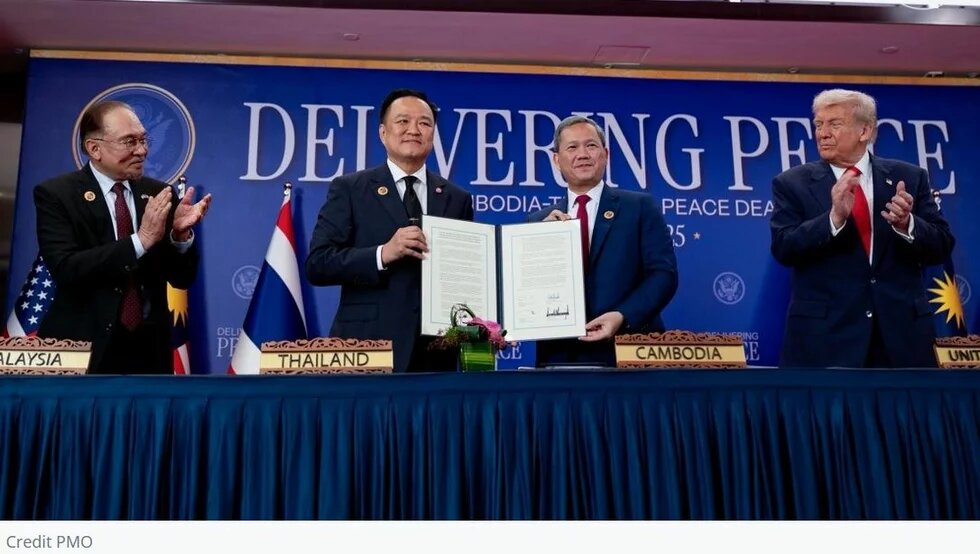
However, the shelf life of Thai-Cambodian agreement that Trump called “a monumental step” has been short-lived. Two weeks later on 10 November, Thailand called off the implementation of the Kuala Lumpur agreement after Thai soldiers were injured in a landmine blast in Sisaket province, by the country’s border with Cambodia.
As of mid-December, clashes between the two countries have escalated to highest level since the current border conflict erupted in May 2025. There were skirmishes in July and again on 7 December, after which clashes were reported at several points across more than 800 kilometres of their shared border. (The fighting continued despite conversations by Anwar and Trump with Thai Prime Minister Anutin Charnvirakul and Cambodian Prime Minister Hun Manet. Trump announced the two sides had agreed on a ceasefire on 12 December but this was disputed by Thailand.)
At the ASEAN meetings, the US formalized trade and economic agreements with Malaysia, Thailand and Cambodia, including on increased tariffs and commitments to buy US products.
Also announced were agreements, not quite publicized before, where the US aims to gain access to rare earths from Southeast Asian countries. This reflected the Trump administration’s worries about US dependence on China and what Lin described as its efforts “to re-anchor Southeast Asia into its own industrial ecosystem, particularly for defense and clean-tech manufacturing”.
Similar US agreements with Malaysia and Thailand pledge “cooperation” on the development and expansion of critical minerals supply chains and measures to “strengthen trade and investment” in these areas. In the US-Cambodia trade accord, the section on investment says Cambodia “shall allow and facilitate” US investment in exploring to exporting “critical minerals and energy resources”.
But some groups and politicians in Thailand and Malaysia have expressed discomfort about giving the US preferential treatment in the development of rare earth materials.
“These deals are double edged,” Lin pointed out. “There is the question of whether Washington is dictating terms that primarily serve its own industrial interests. The fact that rare earths featured so prominently, without much public transparency, reflects both their strategic value and the unease many ASEAN governments feel about being drawn to a US-China resource rivalry.”
Trade, environment accords get done
At its October summit and related meetings, ASEAN also issued major agreements and declarations ranging from trade to the environment.
The priority that ASEAN puts on diversifying trade options and deepening its economic integration amid trade tensions set off by the US’ tariff-based actions can be seen in three trade-related steps and measures. These geoeconomic steps moves “the continued efforts of building inter- and intra-regionalism cooperation”, as Ibrahim put it.
First, ASEAN upgraded its ASEAN Trade in Goods Agreement (ATIGA) with a second protocol, further widening trade in goods under the ASEAN Free Trade Agreement as part of efforts to push up its low level of intra-regional trade (21.4% in 2024). ATIGA is expected to reach “over 99 percent openness” in trade flows, one ASEAN official said.
Second, the 5th summit of the Regional Comprehensive Economic Partnership (RCEP) was held during the ASEAN meetings, where leaders of ASEAN and five other countries (Australia, China, Japan, New Zealand and South Korea) reaffirmed their commitment to an open and rules-based multilateral trading system. The ASEAN-led RCEP is the world’s largest free trade agreement, accounting for some 30% of the world’s GDP.
Third, ASEAN signed an upgrade of its free trade agreement with China, the region’s largest trading partner. This was China’s biggest take-home benefit from the ASEAN meetings. The China-ASEAN Free Trade Area, which came into force in 201o and spurred an exponential rise in trade volume, now covers the digital economy, green economy and supply chain connectivity.
In other areas, ASEAN leaders issued a Declaration on the Right to a Safe, Clean, Healthy and Sustainable Environment, the first regional instrument to explicitly recognize this right and connect human rights and the environment. Though legally non-binding, it has a commitment for the ASEAN Intergovernmental Commission on Human Rights to lead the development of a regional plan of action on environment and rights.
Next, the Philippines – and the South China Sea
As ASEAN chair in 2026, the Philippines inherits a regional agenda with two major challenges - the crisis in Myanmar (ASEAN skipped its turn to chair the organization in 2026) and Thai-Cambodia tensions.
The Philippines is expected to prioritize regional security, particularly maritime security, since it is the ASEAN country taking the brunt of China’s hostile actions in the South China Sea. The Philippines has reported many occasions where Chinese vessels have harassed and blocked its supply and other ships, including around islets and shoals that Manila claims.
President Ferdinand Marcos has been saying that he would like to see the ASEAN Code of Conduct on the South China Sea – which has been under negotiations for over two decades and has shown little progress after three readings – completed during the Philippines’ turn to chair ASEAN. In 2023, China and ASEAN agreed to speed up negotiations on a legally binding code within three years.
Given its worries about China, the Philippines has been investing more in closer security and military ties with the United States, even as it pursues a policy of getting different countries to publicly support adherence to the United Nations Convention on the Law of the Sea (UNCLOS) in the South China Sea.
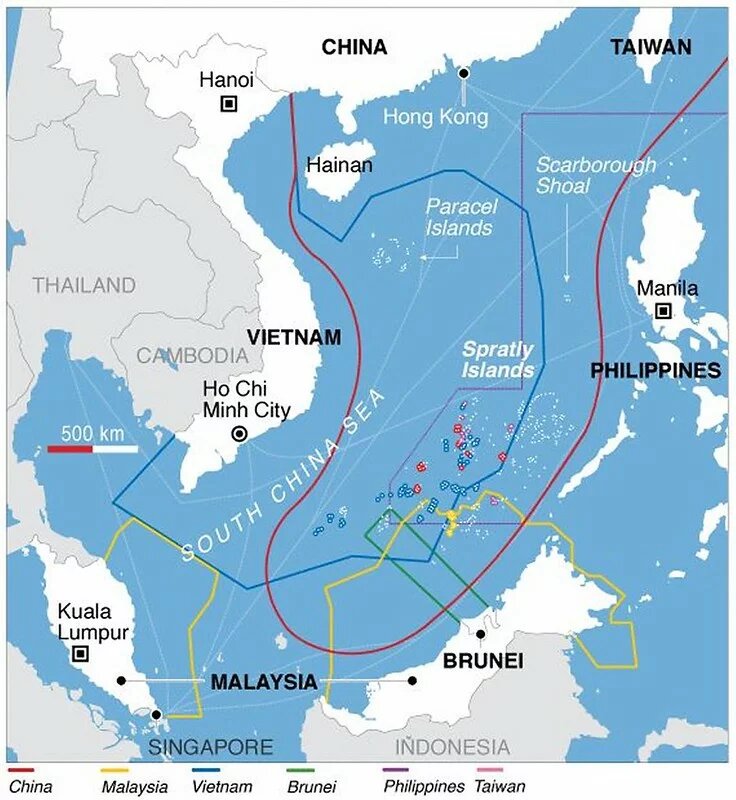
A US treaty ally and seen to be closer to the United States than much of ASEAN, Manila has giving Washington access to more of its military bases. At the sidelines of the ASEAN summit, Manila and Washington announced the formation a new military task force (Task Force-Philippines) to deter aggression in the South China Sea. “We share concerns about China’s coercion in the South China Sea, particularly recently in Scarborough Shoal,” US Defense Secretary Pete Hegseth said.
Against this backdrop, the Philippines needs to play a consensus-building role in ASEAN in 2026 – balancing this with its own concerns although the chair traditionally has room to shape the group’s priorities for the year.
In remarks at the East Asia Summit that sounded like a reminder to Marcos, Anwar said: “We want it (South China Sea disputes) to be resolved within ASEAN and with our partners in the region. Because the moment it is seen to be imposed and dictated by outside forces, things become more problematic and tense.”
Marcos said he agrees with Anwar and has expressed a commitment to strengthening ASEAN unity.
“The role of the balancer is an increasingly challenging one, especially in a region where domestic needs tend to take precedent,” Ibrahim explained. “There is an additional layer of difficulty as the Philippines are growing disillusioned by ASEAN’s capacity to support their interests.”
The country’s theme of ‘Navigating Our Future, Together’ for ASEAN appears to offer the Philippines the space to “realign its national interests with fellow member states and broader institutional ambitions”, Ibrahim added.
At the same time, Marcos told Filipino journalists at the ASEAN meetings: “I really believe that the way forward is to change. Because when you talk about China and the Philippines, all you talk about are the territorial disputes,” he said, adding that there are other ways of engagement with Beijing beyond these. “So, I would very much like to say, all right, we disagree, we agree to disagree, now let’s do other things. And that’s what I will try to achieve in the year of our chairship here in ASEAN,” Marcos added.
__
Johanna Son, who has covered Southeast Asia for over three decades, is the editor and founder of the Reporting ASEAN series, whose newsletter is here.
Disclaimer: This published work was prepared with the support of the Heinrich Böll Stiftung. The views and analysis contained in the work are those of the author and do not necessarily represent the views of the foundation. The author is responsible for any liability claims against copyright breaches of graphics, photograph, images, audio, and text used.