
Interview
"So, this is a long journey – a long and difficult process. But it cannot begin if the majority votes 'No.' in this election. That’s why it’s crucial for us. We know it’s going to be a long fight, but without a majority to support it this time, we can’t even get started."

Thailand’s political process has undergone significant shifts over the past three years, marked by three different administrations, the removal of a Prime Minister, and the dissolution of political parties. Amidst this backdrop, Thailand is approaching its general elections on February 8, 2026,
While domestic news coverage in Thailand often lacks a sufficiently critical lens, reporting in Germany frequently overlooks important contextual details. In our conversation with Anon Chawalawan, we explore the political landscape and the events that have shaped Thailand's current state of governance and democracy. Our goal is to raise awareness of the critical advocacy of the youth and their vision, which should be central to Thailand's political future.
Thailand has been in the headlines in Germany because of the ongoing conflict between Thailand and Cambodia. Is there any connection between the conflict and the upcoming elections?
The elections have a significant connection to the border disputes raised a nationalist sentiment among the Thai population. Since 2014, the military has increasingly been the subject of public criticism - not for securing the border, but for seizing power through a coup d’état and for arresting people who expressed their political opinions.
Of course, there are the right-wing movements, or right-wing groups that support the military, as well as people with conservative political ideologies who support the military. I am not sure whether the concepts of “left” and “right” fits in the Thai political context. However, those groups that proclaim a fight for democracy also tend to reject the role of the military in politics. This affected the election in 2019 and became even more significant in the 2023 election, when a political party with the image of “standing against the dictatorship” gained widespread support.
The Move Forward Party also introduced policies that may have challenged the military. They sought to abolish forced conscription, while at the same time, emphasizing that they were not the enemies of the military. Their goal was to professionalize the military and prevent it from interfering in politics. They gained a strong public support at that time.
Because of the dispute between Thailand and Cambodia in 2024, more and more people expressed sympathy for the military, particularly for those who lost their lives during the conflict. So, the phrase “What are the military for?” - once used to criticized the military for interfering in politics – has backfired against the People's Party, the successor to the Move Forward Party dissolved in 2024. Today, the military is seen as a hero, fulfilling its duty, unlike the politicians.
When we see the evolution of Thai politics since the 2014 coup d'état, we see the rise of the progressive movement opposing military power in politics. This also helped establish the Future Forward Party in 2020, which the youth embraced as a new alternative. After the party was dissolved in 2020, dissatisfaction among the Thai youth grew and later led to the major protest that same year. That movement also brought about many issues; apart from dissatisfaction with politics, it is also expanded to other demands, such as “We want a new constitution”.
Could you please share with us more details about the developments around the constitutional referendum that will take place on election day, February 8, 2026?
The current constitution in place is the constitution of 2017. At that time, the military junta appointed legal experts to draft it and then submitted the draft to a referendum. We could say this was a “referendum in brackets”, because political gatherings of five people or more were not allowed. People had to vote but without equal access to information, since opponents of the draft were unable to campaign freely. Also, the military did not clarify what would happen if the draft were rejected. Which constitution would then apply?
People really wanted to have an election at that time, because without an elected government the economy was also affected. So, people wanted to make sure that there was going to be an election. Many feared that if the draft constitution was not passed, a new one would have to be written prolonging the wait for the elections. The last constitution referendum in 2016 took place under this scenario. On one hand, opponents could not campaign freely. On the other hand, people also felt insecure, not knowing what would happen if the draft constitution was rejected and the election was delayed. These factors contributed to the majority support for the draft. Of course, some genuinely supported the constitution because of its content, but many voted “Yes” simply because they saw no alternative. After the constitution was promulgated, we continue to live under the military regime until election was finally held in 2019.
That constitution contained several problematic provisions, including one that required, for the first five years, both the Senate and the House of Representatives to vote together for the Prime minister, while the Senate was appointed by the head of the military junta. The last time that the Senate voted for a Prime Minister was in 2023; since then, this provision has expired. For the upcoming elections, only the members of the House of representatives will vote.
For the upcoming elections, each political party must submit no more than three names as Prime Minister candidates. These candidates do not need to be members of parliament or even member of the party.
In the 2023 election, the two parties that received the highest votes came from the former opposition coalition. The Move Forward Party surprisingly won the most seats, far beyond all expectations. However, because the temporary provision of the 2017 constitution was still in place, the Senate appointed by General Prayut – was able to vote for the Prime Minister.
Who are the important political parties that are relevant for the upcoming elections?
There are three parties considered major players in Thai politics. The first is the People's Party, successor to the Move Forward Party, which won the most seats in the 2023 elections. The rise of the Move Forward Party reflected the decline of the conservatives. During the 2023 campaign, Move Forward introduced several progressive ideas, most notably was the abolition of forced military conscription. I think they will have fewer votes because of scandals surrounding its candidates which have damaged the party’s reputation. In 2023, Move Forward Party used the campaign slogan “You have us, there is no Uncle" (มีเราไม่มีลุง), referring to General Prayut. But this time, their slogan is "You have us, there is no gray" (มีเราไม่มีเทา). Gray means ‘no illegal activity’ which is kind of abstract and intangible for the voters.
The second major party is the Bhumjaithai Party, meaning “proud to be Thai”. They have actually become more prominent and they usually have their base at the provincial level. In the previous election, they held about 60 - 70 seats out of 500 seats in the Parliament. But this time, Bhumjaithai is on the rise. First, the leader of the party, Anutin Charnvirakul, served two important roles. First, as Minister of Health and later as Minister of Interior. Second, in 2025, he had an opportunity to become prime minister, even though his party has only 70 seats. This happened after the prime minister candidates of Pheu Thai Party was dismissed by the Constitutional Court twice. First in 2023, Srettha Thavisin was dismissed because of moral principles, violating the "rules on ethics" for appointing a former lawyer who served jail time, and in September 2025, Paetongtarn Shinawatra, was dismissed. At that time, the People’s Party, despite winning the most votes, had also been dismissed and did not submit a candidate.
The People’s Party finally decided to vote for Bhumjaithai Party,’s prime ministerial candidate because they wanted to make sure that the constitutional amendment could move forward. They proposed that they would not become part of the government and that they would vote for any candidate who accepted the condition of dissolving Parliament to dissolve the parliament within four months of taking the premiership. So, the party with only 70 seats managed to become the leader of the government coalition.
The third major party is Pheu Thai, a long-standing force in Thai politics. You could say that the Pheu Thai Party is the third generation of Thaksin Shinawatra’s political legacy. Thaksin, a former tycoon and police officer, served as Prime Minister from 2001 until 2006. People believed that he brought in new policies – for example, the universal healthcare scheme. So, he is very famous.
But the popularity of the Pheu Thai Party did not only emerge because of parliamentary politics but also in mass movements. Supporters of Pheu Thai formed the "Red Shirts." They organized protests in 2010 demanding the dissolution of parliament and a new election, during which some protesters were killed in Bangkok. Pheu Thai Party governed after winning the 2011 election and in 2023, became the second-largest party, retaining a strong base of support.
Another interesting factor is the return of the Democrat Party and Abhisit Vejjajiva who served as Prime Minister in 2009. In 2010, his government oversaw a crackdown on Red Shirt protesters. Abhisit represents a conservative ideology, but in Thailand, the term "conservative" has many different layers. The Democrats’ popularity declined after a leadership change in the last election. They hope that with Abhisit Vejjajiva’s return will help them regain support, particularly in Bangkok. The Democrats have also been popular in the Southern region.
The thing about this election that I want to highlight is the role of the Constitutional Court.
The Constitutional Court dissolved the Move Forward Party for using Lèse-majesté reform as part of its campaign platform. The Constitutional Court has ruled that in 2026 elections, no political party may use Lèse-majesté as part of its campaign. So, this time, debate on this issue has been removed entirely, narrowing the range of topics that can be discussed during the campaign.
What are the major concerns of civil society for the upcoming elections?
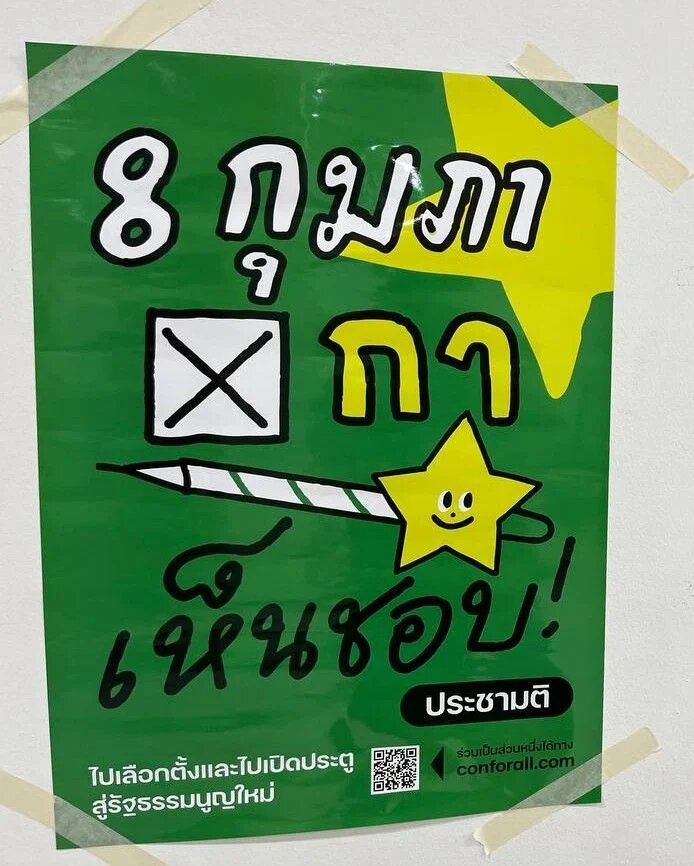
Right now, what we as civil society are concerned about is the Constitution. If we don’t want to live with the Constitution that was drafted by the military, then we have to campaign for the people to vote 'Yes'. Many organizations prepared for that. We identified how we can seek public support and how the public can engage in this crucial referendum. We prepared many publications and documents, and we encouraged people to distribute them in their areas and to organize activities related to the referendum. Recently, we also encouraged people to mobilize a mass movement – for example, every Wednesday since the beginning of the year we have run campaign where we wear green T-shirts with the message that we want to vote 'Yes' for the Constitution.
|
|
|
In order to have a new constitution, we need to go through three referendums. The first referendum poses the question of whether the people want a new constitution or not, which is the referendum we are going to vote on the 8th of February. If it passes, then Parliament will have to decide the procedure for drafting the new constitution. When that process is done, they also need to put it on the table for a second referendum. If that passes, the drafting process will continue. After the draft is final, it will be submitted for a third referendum. So, this is a long journey – a long and difficult process. But it cannot begin if the majority votes 'No.' in this election. That’s why it’s crucial for us. We know it’s going to be a long fight, but without a majority to support it this time, we can’t even get started.
One challenge for us is our demand that the drafters be elected by the people the same way we elect our MPs. But the Constitutional Court ruled that the Parliament cannot allow Thai voters to elect the constitution drafters. So, they now have to work through a complicated idea of how public engagement can still be ensured without electing the drafters.
How do you structure your campaign work as civil society this year?
Actually, we have two different campaigns right now. The original campaign we call "Vote 62". The number 62 refers to the year in the Buddhist (2562 B.E.) era when we had the vote in 2019. At that time, our concern was that we were not sure whether the election result was going to be tampered with. We mobilized the public during the previous elections to remain at the polling station after the vote. During the counting, we asked them to observe and to make an objection in the case that the officer at the polling station made a mistake – for example, if they deliberately declare a "good" ballot to be a "bad" ballot. You could protest at the scene, and you could also check whether, for example, the person holding the ballot said "number three" while the person ticking the counting board ticked "number two." In that case, you could protest. So, we want that, and we want concrete evidence.
We found that in 2019 people were really active on election day. If they noticed that the polling station authorities did not comply with the regulations or did not do what they should, the people protected the process. We see this as a campaign platform where people can engage directly with the process and see how they can be a part of it. So, we are continuing with that this year. But from the past two elections, we did not have enough information because the pictures we had were not numerous enough to make any definitive claims. Nevertheless, we see that this campaign, is still crucial - not only to bring people to engage in the process, but also because we are going to have three ballots that need to be observed. And we can already speculate that there will be human error. We want to make sure that there will be eyes and ears in every polling station to ensure that all the ballots are counted and represent the political will of the voters.
Another thing that we now are much more focused on is the referendum. If this time we lose – if the people vote that they do not want a new constitution or they do not want a constitutional amendment – it will be difficult to make any political change. It is crucial for us that we achieve not just a simple majority. For political legitimacy, we need to reach high as 20 million votes, so that we can say that, “Okay, this is the decision of the people – that we want to start over again. We want a new constitution where people have a way to participate in the process. And then we will accept and abide the constitution that is ultimately adopted.
When you look at the young generation in Thailand, are they going to participate in this year election?
This year, it is difficult to answer this question. In the last election in 2023, I think the youth played a big role. They went back home and asked the elderly in their families to vote for the Move Forward Party. That was one of the factors that contributed to the win at that time. That election carried high hopes, because people wanted to move out from the shadow of the military. It was an election where people hoped for change. But this time, I don’t know. Things are unclear as to which direction we will go. Some assume that even if you vote, things are not going to change. Some even predict who will become the Prime Minister already. We are going to vote anyway, but certain outcomes can already be foreseen.
And where does, political debate among young people take place during this time run up to the elections, on Facebook or on other social media?
Not really Facebook. In 2020, it was Twitter, but I guess that is not the case anymore. Many of them moved to Instagram, but the application that plays a major role now is TikTok. People consume short videos there, and TikTok is used by all sides for their campaigns. But one thing we have seen among the older generation - now the majority in this country as we become an aging society – is that a lot of false information is distributed through the Line messenger application. What we try to do is counter disinformation. We look online to identify false arguments about the constitutional amendment and the drafting of the new constitution that have been circulated. We try to respond to that discourse.
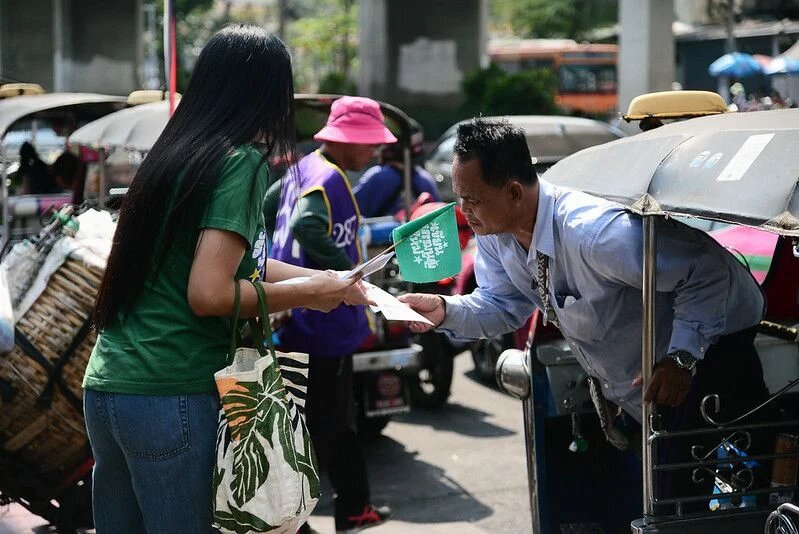
On the other hand, even though we are in the digital age, we still think that to have our information reach a wider audience, we need more than just online efforts. In the online world, algorithms lead your information to certain groups and not others. So, we also try to use distribution like print media. We even have volunteers who go to the markets to meet actual people and distribute pamphlets and our election manual.
There are many volunteers. We have a website we for this campaign called 'Con For All.' We have about 598 informal information distribution centers. These are mostly restaurants, coffee shops, bookshops, or any business that deals with the public. They just ask us, “Can we bring your materials to distribute at our business place?” So right now, we have 598 spots in 226 constituencies. We also produce stickers to use as campaign material. We are trying to mobilize support as much as possible.
Is there any final statement you would like to put on record?
Even if the election is uncertain, we can be certain that we need a new constitution. We hope it will open the door to new opportunities. If we are still constrained by the 2017 Constitution, it will be difficult for any political party. So right now, we need to focus on the Constitution. If the structure is sound political parties will be freer to propose their dreams and policies in the next election.
__
Anon Chawalawan is a founder and director of the Museum of Popular History, he is also serving as manager of iLaw, a Human Rights organization in Thailand.
Disclaimer: This published work was prepared with the support of the Heinrich Böll Stiftung. The views and analysis contained in the work are those of the author and do not necessarily represent the views of the foundation. The author is responsible for any liability claims against copyright breaches of graphics, photograph, images, audio, and text used.


